What does the digitization and mediatization of space mean for our physical and virtual knowledge spaces. How can architectural and interface design promote innovation and creativity through their spatial configurations and protocols? Which new approaches need to be deployed so that complexity is created instead of reduced?
Preface
Complexity has become a key concept in the sciences. It contradicts the linear and schematic way of approaching the world around us through static and universal knowledge, but rather promotes the fluid and networked entanglement of phenomena. The approach of complexity is based on the insight that each analyzed situation is multidimensionally and transdisciplinarily informed by a multitude of agencies, contradicting the one-dimensionality of conventional knowledge conceptions. But to remain in a position to understand and actively shape our more and more complex realities, spaces are required that can equally (re)produce these convoluted relations. The way how we deal with knowledge today, our educa- tional and learning spaces but also our working environments in general, dramatically lack these qualities. Also, because they insufficiently incorporate the tools we have at our disposal, namely our contemporary digital technologies, which are the instruments that opened the door for us to detect and analyze complex- ity on a broad scale in the first place. To think complexly means to think with the help of technology, or put differently: technologically mediated. My project is the attempt to therefore actualize one of our most central spaces of knowledge-interaction: a library. How can we as designers and architects create shared spaces that enable complex modes of knowledge retrieval, exchange, or generation and that frame collab- orative cross-border work settings?
When I started my master’s studies at the University of the Arts Berlin in fall 2018, I got into a project group that intended to research possible synergies of digital technologies implemented in spaces of education and learning. Of course, we were aware that this task could hardly be answered by us archi- tects alone, and so we initiated an open format of events and seminars for interdisciplinary encounter and the exchange of knowledge within UdK (Digital Salon). Out of this discourse the question arose how ar- chitecture can contribute to more complex modes of learning and working together. In the early stages of the project, I purposely let my attention and interest wander and dug into different fields of research that seemed related. This “undisciplined” way of connecting contents was the basis for the development of the transdisciplinary approach outlined in the following thesis. Correspondingly, in the project different tex- tual lines from different disciplines (inter alia: architecture, philosophy, cultural studies, computer science) converge to form this heterogeneously informed argument. However, the project is neither a conven- tional architectural project nor a scientific paper. I like to see it as an “architectural essay” that blends conventional forms of presentation into a web-optimized experience.
1 Research: A media revolution
1.1 Tree-knowledge
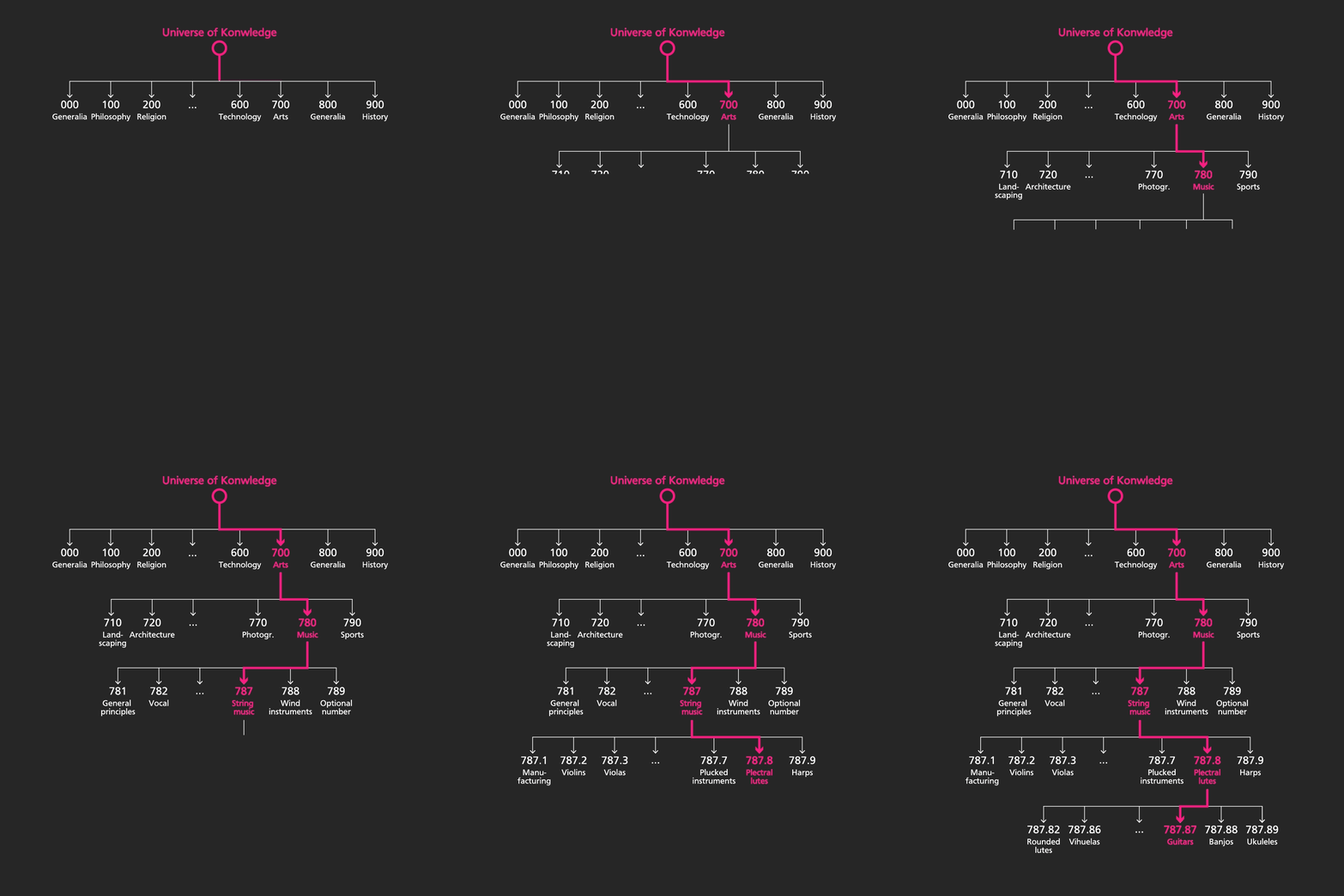
In the aftermath of the enlightenment the emerging sciences were based on a particular form of thought – a conceptual figure for the fundamental organization of the world that can be summed up with the visual metaphor of the "tree". Central in this conception is the hierarchical structuring of knowledge. Thereby a small number of statements defines and controls vast quantities of statements on all subjacent levels – from highly abstract at the bottom, to very concrete pieces of knowledge at the top. This modern knowledge organization seems to be intuitive – even obvious. But this way of making sense of the world is a constructed one. It doesn’t represent a seemingly natural order but rather enforced a very much human made logos on natural phenomena. It’s needless to say that this epistemological regime was and is highly productive, but there was a price to be paid for this hierarchical order.
The genealogical organization only allows linear, one-dimensional relations and thus introduced a binary mode of classifying knowledge separating all entities of the modern knowledge system into fragmented, specialized branches. Therefore, every entity had a fixed position within the overall structure of the tree, its branches, and their inner ramifications/differentiation. In this logic horizontal or cross connections weren't possible. And out of this urge to keep things (literally) in line and therefore manageable, disparate silos of thought and practice (hence knowledge) emerged that then defined the disciplinary landscape of modern sciences.
Another, even more important implication for our case is that with this hierarchical mode of organization the contents of knowledge consequently had to be reduced when referred to on their way down. Since superordinate points received many streams of information coming from above but could only pass on one channel further downwards, the contents had to be merged, synthesized and/or subsumed before. In this process a high percentage of what was written on higher levels got inevitably lost resulting in an accumulative reduction: the further down in the tree-diagram, the higher the level of abstraction and the more detail and nuances are filtered out.
This epistemological reductionism resulted in a form of thought that tended to homogenize and abstract. The universal formal structure was always already there, just waiting for the bits of knowledge to be fitted in. But obviously, the world is and always has been more complex than a simple tree diagram could suggest. Then why was it organized in this reductionist manner? There is of course not one single answer to this question. Many influences contributed to the emergence of this in itself highly complex situation. There is the generally hierarchical/monarchical design of most 19th century societies for example which are themselves based on the far-reaching religious belief of a god-created, natural hierarchy. But I want to suggest that there might be another complementary argument that gives attention to the technological circumstances of the time. Namely that the reduction of complexity and differences was partly inevitable because the systemic, technological parameters didn’t allow for any higher extent of information processing and consequently had to result in a systemic reductionism.

1.2 Thinking paper-based
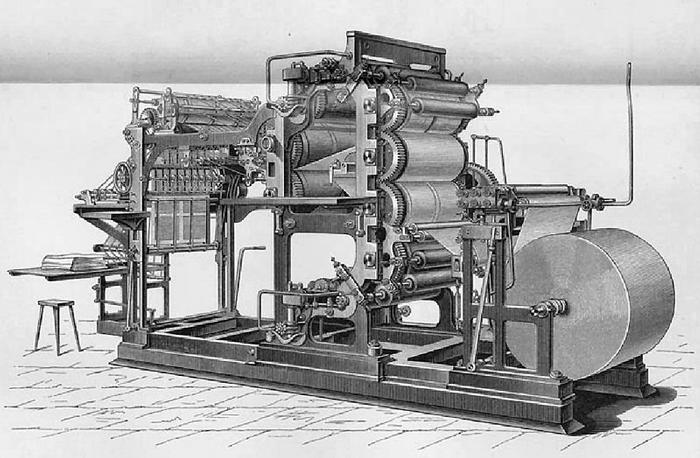
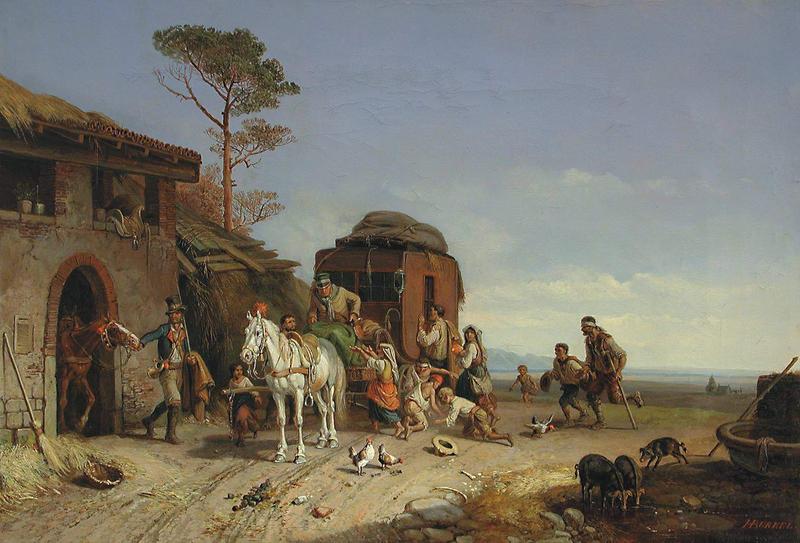
The hypothesis is as follows: The formation of the reductionist tree-knowledge can only be understood by considering the specific socio-technological conditions of the 19th century – a period in which the tree-knowledge got widely distributed in academic spheres and beyond. It was the material milieu for this particular mode of knowledge organization to emerge. The central technological and cultural artefact that shaped the emergence of those systems was the book. Around it social practices and protocols evolved that formed interdependent assemblages of both, technological and social. As the primary mean for knowledge communication and storage the 19th century academic societies created themselves with all their intricate procedures, rituals, normativities around the technological medium of the book. It limited the memory size of the single data carriers. It defined the speed of “reading” or retrieving the data. Its reproduction was tied to the performance of the industrial letterpress printing. The postal sector [defined] the speed of data transmission. An academic library of the time couldn’t be imagined without any ink on paper. Consequently, librarians had to face the incoming stream of knowledge/books with the tools and the organizational protocols (e.g., the library catalogues) available at hand. All these factors defined the overall capacities and performance of the information-processing system. Humans themselves were only one component in the complex of technological, economic, and political conditions in total. And regarding the relatively limited means the librarians had no other choice than applying the method of reduction to make the sheer infinite amount of knowledge manageable or even navigable in the first place. My suggestion is therefore as follows: Knowledge can’t be understood independently from its material context. For the 19th century the increasing imbalance between the quantities of knowledge and the possibilities to process it led to the emergence of an epistemological structure based on reduction through labelling. The contingent metaphor of the tree was just one possible form of structuring. Taking the historical circumstances into account the tree was just more obvious than others.
1.3 Hyperlinked reality
Today, our social as well as technological conditions drastically differ from the time when our still often prevailing epistemological structures were formed. Only a few decades ago every analog medium (newspaper, radio, television, etc.) was organized rather independently. Due to their differing medial properties, there was only limited communication between them so that they functioned complementary. By the notion of digitalization this medial compartmentation is now replaced with a vast, homogeneous, digital infrastructure that tends to combine all symbolical transactions into one single medium. With the help of computers, the whole world gets seamlessly translated into digital signals. And thanks to the internet these bits and bytes are then automatically circulated, processed, and networked back into the system. The resulting extracts of data are often so big that they can’t be analyzed anymore by us humans alone, but only with the aid of computers again.
Any media has always been an “extension of man”, extending not only our physiological but also our cognitive features. With the rise of digital media, a new door seems to have opened to formerly unknown depths of reality. Reduction was and still is inescapable. The world simply holds too many wonders for us to even register them, let alone understand. But what is different today is that we have new allies to meet our “wicked” presence. Not only can amounts of data be processed in seconds that would have taken several human lifetimes in the analogue age. But also, through the networking capacities of contemporary technology, silos of thought found a common, communicative infrastructure which used to be separated into disparate social and epistemic disciplines. As a result, a multiplicity of new connections is made bridging the demarcations and creating new fields of joint research. Slowly, a new understanding of knowledge emerges that works transdisciplinary and pays close attention to those intricate entanglements.
Tree-knowledge is not able to represent these kinds of non-linear constellations because of its very limited organizational capacities. In this way, material reality has already transcended our conceptual and terminological framework. And contrary to the simple principle of linear reduction of the tree-knowledge there is an emerging awareness for complexity. A system can be identified as complex if its causal categories are intertwined in a non-linear manner so that their sum is greater than the single components. This means that the movements and flows in the system aren’t predetermined and can’t be fully predicted. Complex systems resist the idea of a preexisting and stable formal structure. The lateral interaction between the entities leads to modifications of their own qualities and the relations between them. Accordingly, their ontological functioning is based on emergence and self-organization. Tree-knowledge works in a much different way. In its hierarchical structure there are only linear relations possible meaning that every property of an entity must be easily deducible from its superior. In this system therefore the whole corresponds exactly to the sum of its parts. It postulates an ever static and stable framework with which every knowledge entity must coincide because of the assumed essentialist nature of things.
Today, there is a discrepancy between our still traditional understanding and organization of knowledge and a completely different technological reality. Therefore, I think that from an epistemological standpoint there is no technological need any more to rely on the reductionist principles of the modern knowledge classification. Back in the day there was no way to work with multidimensionally complicated data the same way we do it now with the help of algorithms that run on our personal computers. Also, something as fundamental as change was so challenging to be taken in into account so that it had to be suppressed to a minimum. Contrary to that, the networked computational power of contemporary digital technologies allows for non-linear modes of organization that have structural instability and change at its very basis. We are now able to extract more and different kinds of data, circulate those huge amounts with highspeed and process all this material with much higher degrees of complexity. Against this backdrop, complexity here means that the enormous leap in terms of greater quantities also comes with altered qualities. We now see ourselves confronted with the multifaceted nature of things that necessarily had to be ignored because they were structurally so difficult to handle for predigital epistemological communities. The non-trivial, the wicked problems, the hybrids and non-binaries have come to the forth. Complexity is not a problem anymore, but a challenge.
2 Interface: Computing complexity
2.1 A hybrid data pool
There is no overarching, stable order of the world. And if there was one, we shouldn’t imagine that we could ever be able to grasp it in its full complexity. But we can try to approximate it, get closer to it, and take as many significant influences as possible into account. In this way every real-world phenomenon becomes a unique network of mutually informed agencies. To scientifically deal with those singular assemblages, we shouldn’t press them into an already existing scheme until they fit but need to come up with a tailored approach for each of the analyzed situations.
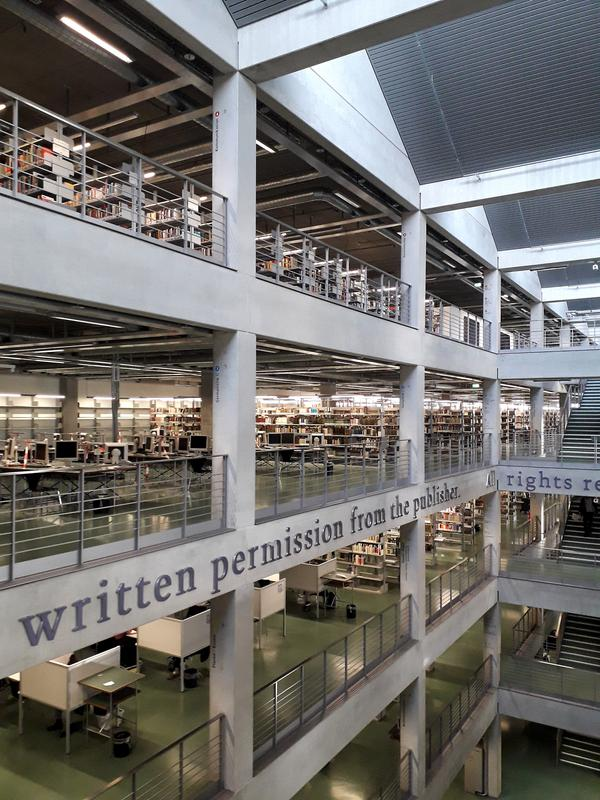
What does all this mean for the example of the library? Every person, every organization, every culture has individual and distinct preconditions for acquiring and maintaining its knowledge. This circumstance makes it impossible to generally speak about the entirety of all libraries. Rather, I decided to choose one as my object of investigation: the Volkswagen University Library [VW Bib] in Berlin combines the collections of the library of the Technical University [TU] and the University of the Arts [UdK]. Therefore, it compounds a heterogeneous pool of knowledge and provides a space where students and researchers of diverse backgrounds go to. Furthermore, as a university library it distinctly functions as a service institution for the retrieval of knowledge supplementing academic work and research. Lastly, this library has been accompanying myself for a while. As a regular user I developed an elaborate relationship with it that can be considered as a sort of expert knowledge from a user-experience point of view. I have a sense about the spatial characteristics and the behavior the building promotes or tends to prevent. In my opinion this insider perspective is very much needed to create sustainable findings.
But to go into the depths of the knowledge system of VW Bib it requires more than analyzing it on an architectural level. Rather, this surface level of spatial materialization was formed around the underlaying systematization of knowledge. Or put differently: to understand the physical, architectural level you first must understand the knowledge system it was built for. Let’s therefore have a look at the library catalogue and how it functions. Like the big majority of German-speaking libraries VW Bib’s catalogue uses the Regensburger Verbundsklassifikation [RVK]. It can be regarded as the German variation of the Dewey-Decimal-Classification [DDC] which is the most utilized knowledge classification system for libraries worldwide. Established in the mid-19th century by Melvil Dewey, a librarian working at a college library in Massachusetts, it can be considered the representative peak of the tree-knowledge. Out of an excessive rationalist manner it organized the entire “universe of knowledge” in a decimal logic. The ten main categories are each organized into ten further subcategories, which subsequently have ten subordinate categories, and so on. From today’s standpoint the rigidity of that approach seems bizarre, but the relevance of the DDC can’t be underestimated in my opinion. If we think of a library today, we implicitly think of these sorts of classification systems. The RVK follows its original’s conceptual guidelines and only introduced small adjustments. For example, the strict organization in decimals was abandoned: Instead of ten main categories the RVK has 34. But the differentiation into strictly separated and hierarchically organized categories works just the same and therefore represents the linear and static tree-knowledge, too. This organizational approach wasn’t restricted solely to the management of knowledge but rather represented a general mode of thought throughout the modern era. With the transition from a paper-based-society to a digit-based-society I want to propose that this form of thought is now undergoing a transformation.
2.2 Networking knowledge
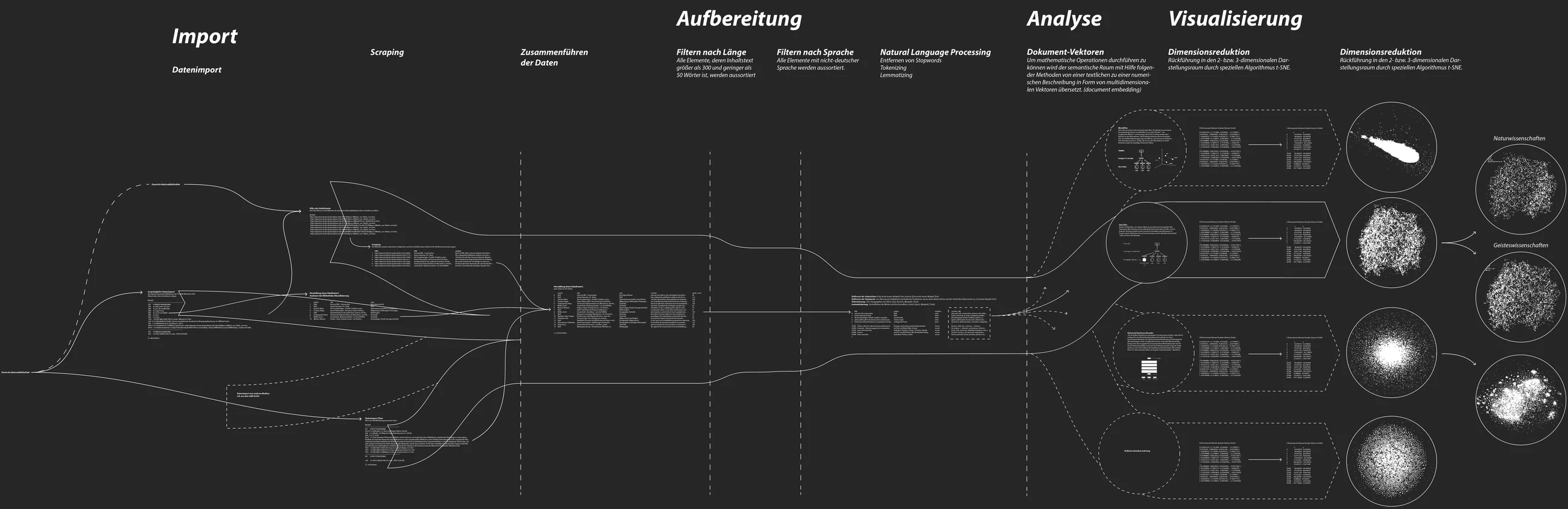
So, how could a different method for organizing the knowledge pool of VW Bib look like that makes use of the processing power of digital technology and potentially escapes the reductionist predicament to create higher degrees of complexity? Let’s recap that librarians had to resort to reductionist strategies because the sheer amounts of knowledge that entered their libraries in the form of books exceeded the processing capacity of the system – humans, with the help of their limited technological facilitators could only go through them on a superficial level resulting in the labelling of their contents. Digital technologies are no longer subjected to limitations like these. Not only can algorithms that run on potent hardware go through way bigger amounts of data in much shorter time, they also can analyze it in a very profound or multidimensional manner. The way I use the term multidimensional in this context originates from how natural language processing [NLP] algorithms work which are commonly used to extract the semantic meaning of text documents. These software packages are trained through machine learning to translate words and sentences into mathematical vectors, which are then embedded in a geometrical space of several hundred dimensions. The higher the amount of dimension, the higher the amount of analyzed linguistic features and the better the capture of textual nuances. Suppose we feed all the data from the existing library system into these algorithms: the publications could be arranged only regarding their similarity to each other on the semantic level without the need for a static framework. The more similar their contents are, the closer elements are to each other within the multidimensional space. Because every entity’s position is defined by its relationships to all the other entities of the system the resulting configuration then can be called a network. Whenever you add or change one of the singular parts the entire network accordingly would change its form. In this sense the tree-logic is inversed: not the whole vertically defines its parts, but all the parts horizontally determine the whole. And through the constant modification of the knowledge pool this whole is everchanging, never has a stable form. That approach also doesn’t rely on reproducing the reductionist categorization into scientific disciplines. Instead of a binary logic (in which an entity is either part of a category or not) it introduces a facetted distribution (in which every entity has graduated degrees of similarity to all other entities). Against this backdrop, transdisciplinarity therefore becomes a mandatory requirement.
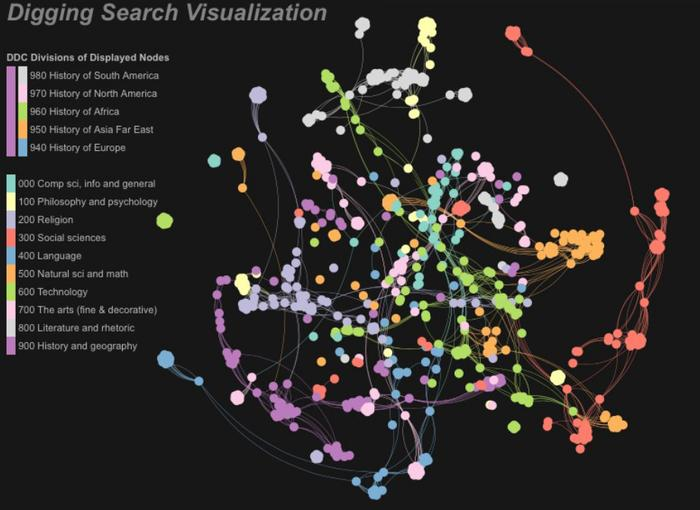
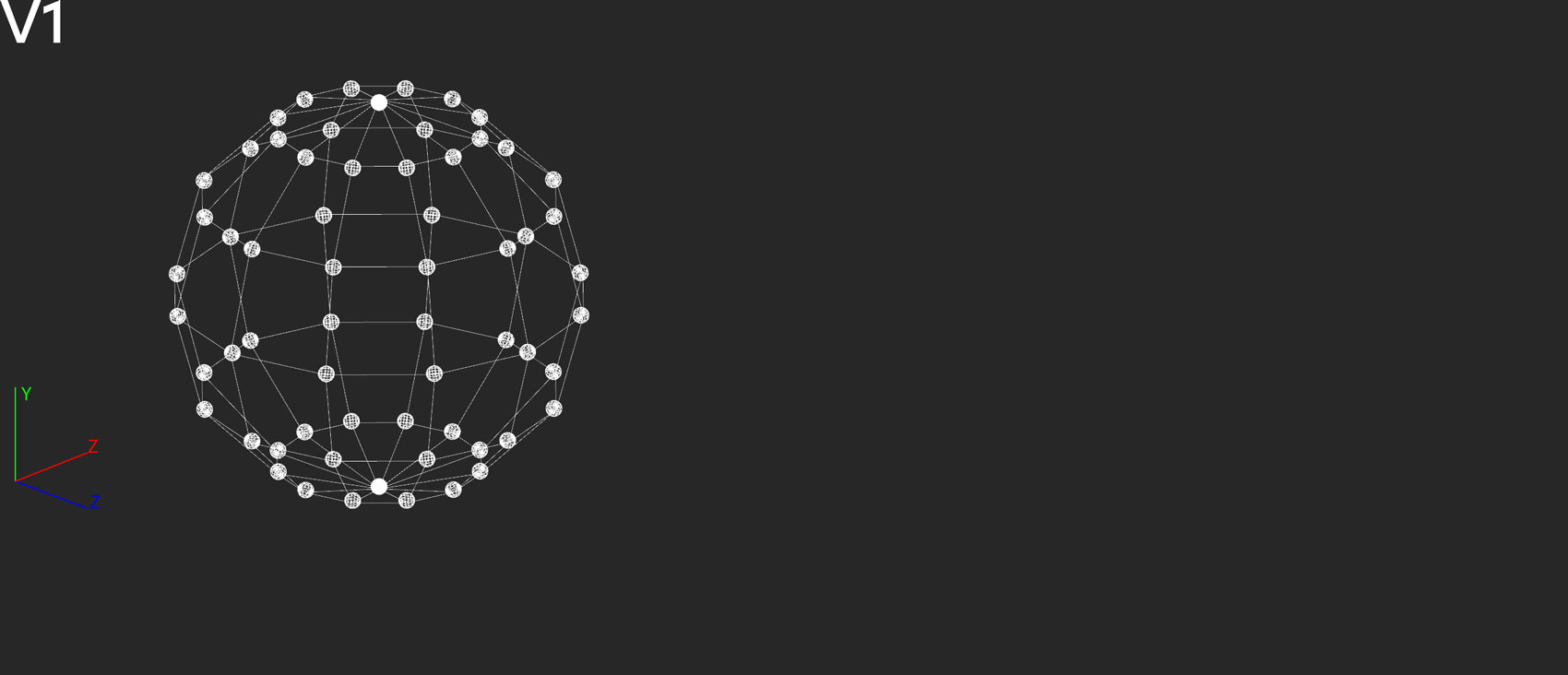
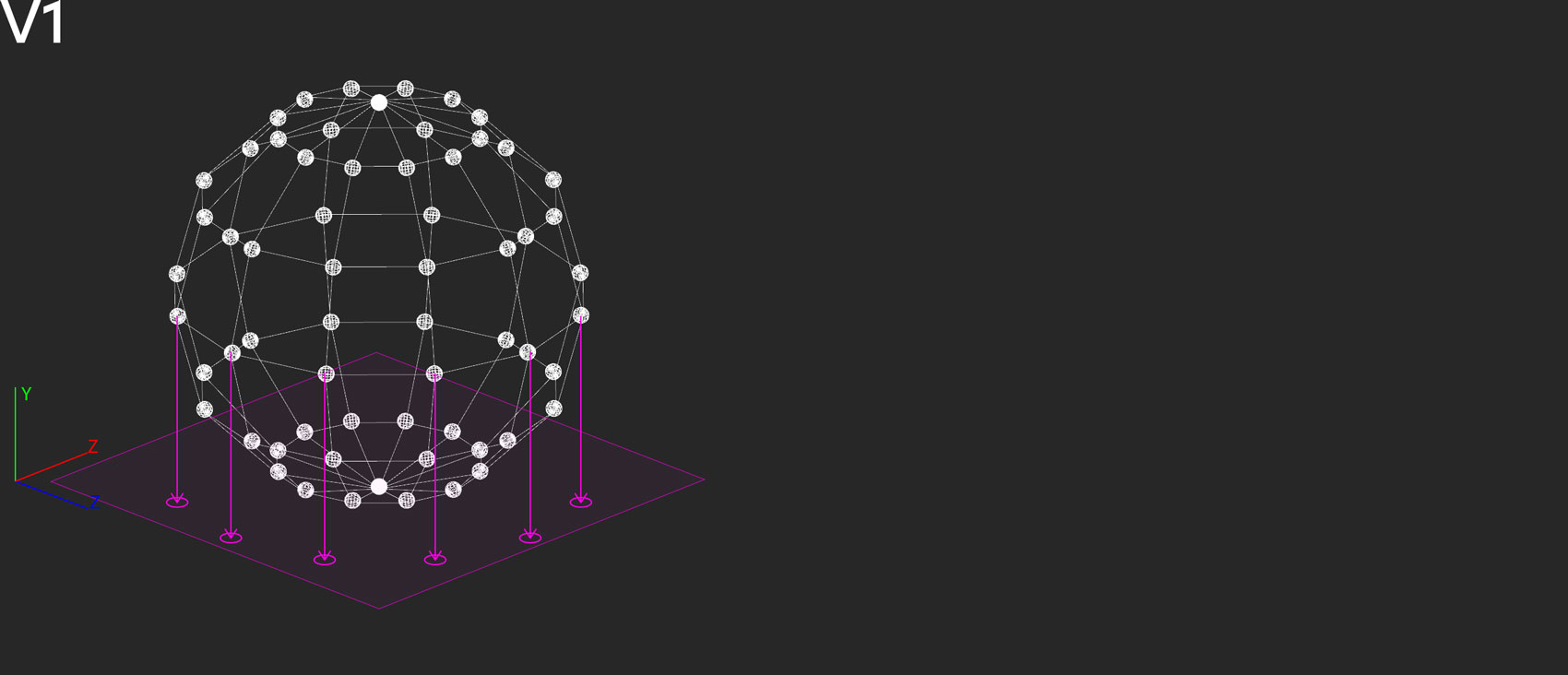
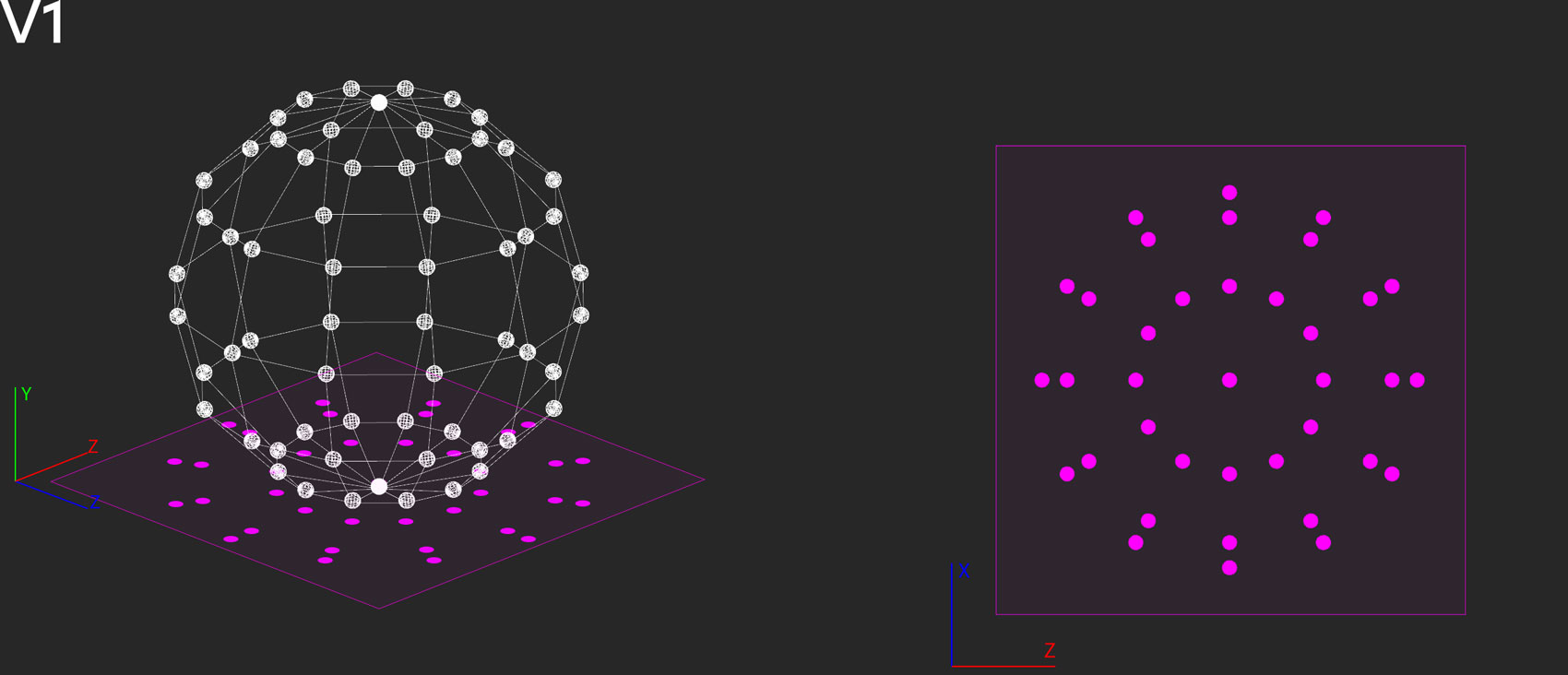
Similar approaches were already implemented by others and as the two examples on the right demonstrate visually compelling results can be reached. They show very well how much these representations differ from the conventional kinds of knowledge structures. But apart from the fact that they both are still images that don’t really depict the dynamic flux every network is characterized by, there is a more fundamental concern that can be critically remarked. It addresses the issue of dimensionality reduction. In the explanations above regarding the NLP algorithms I mentioned that they operate in mathematical spaces of several hundred dimensions. A graph (like the two examples) obviously only has two dimensions. How do you then get from let’s say 500 dimensions to 2? This issue is trickier and more significant than it might appear at first, so let’s have a look. Our point of departure is the high-dimensional space that the NLP algorithms leave us with. In all these dimensions, the full relational richness of the publications is stored. Now, there are different ways to access this highly complicated data. The most common approach is to reduce the dimensions so that we can graphically represent the space with 2 or 3 dimensions. The simplest way to do that is by the geometrical operation of projection. To make this clearer we can use the example of projecting 3d-data on a 2d-plane, as the graph (V1) shows below. The dimensionality will be successfully reduced from 3 to 2, but in the process distortions between the original higher-dimensional relation occur. Consequently, the outcome will lose a good part of its validity. For the method of dimensionality reduction this circumstance is almost unavoidable. Of course, there are more sophisticated stochastic methods than simple projection (e.g., t-SNE) that try to keep more relational information through clustering the data. But even in this case much of the original complexity and textual equivocality is lost.
The urge to boil vast collections of publications or other knowledge representations down to a 2d plane is very much understandable (and has a long tradition). We want to rationally and individually (therefore reductively) make sense of these sorts of epistemic collections because we are used to do so. But in my opinion, intelligent algorithms introduce something that goes beyond the single brain. Let’s illustrate that with a different way of how we could deal with the high-dimensional dataset. It proposes another mode of relating to knowledge that corresponds to the postulate of complexity and manages to escape reductionism: Let’s call it the situational approach.
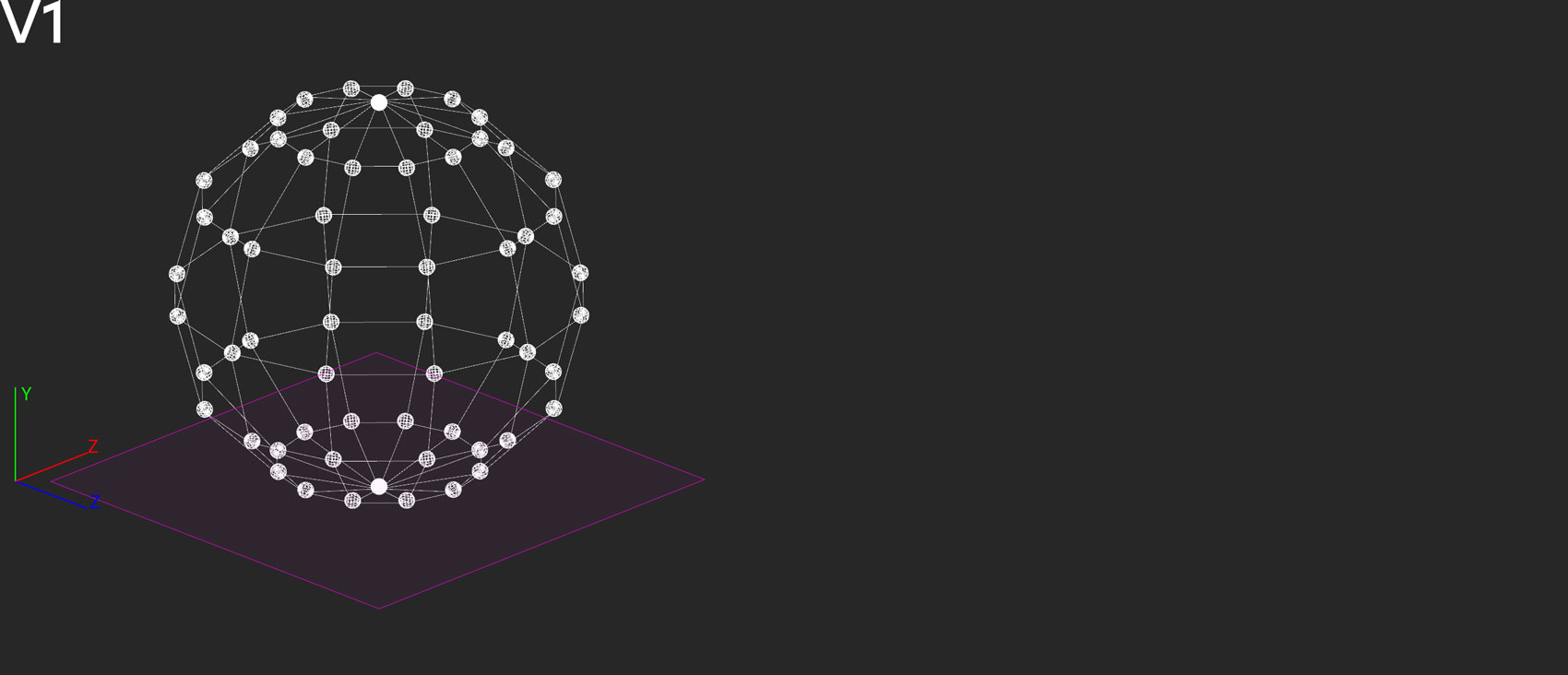
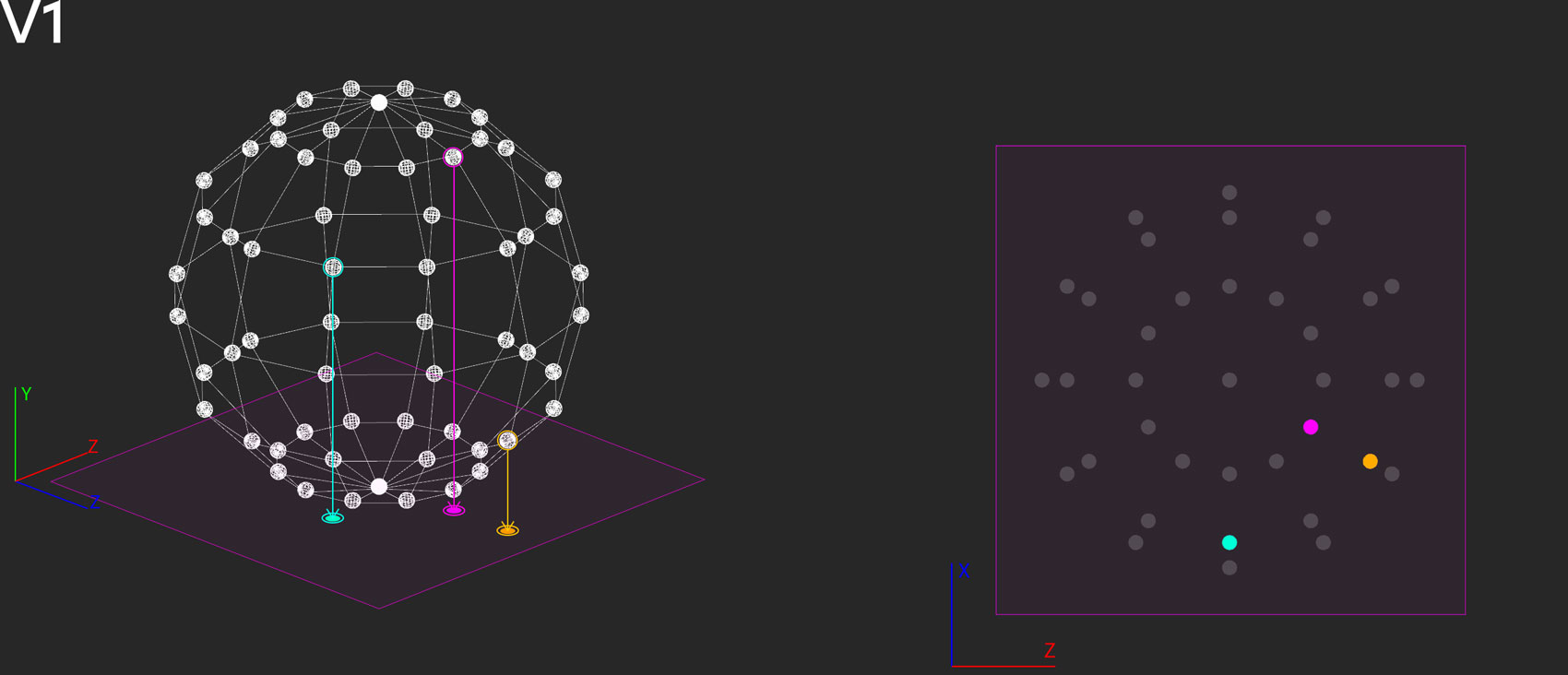
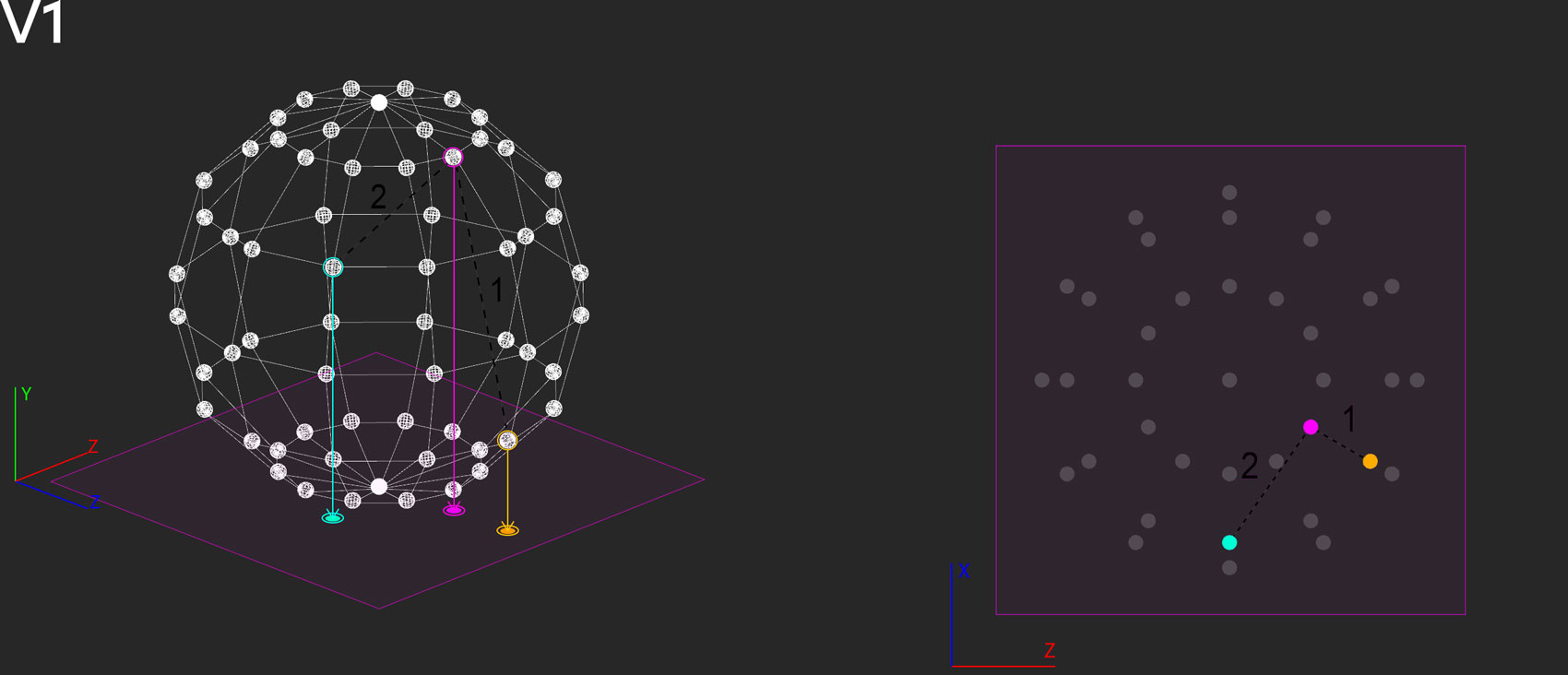
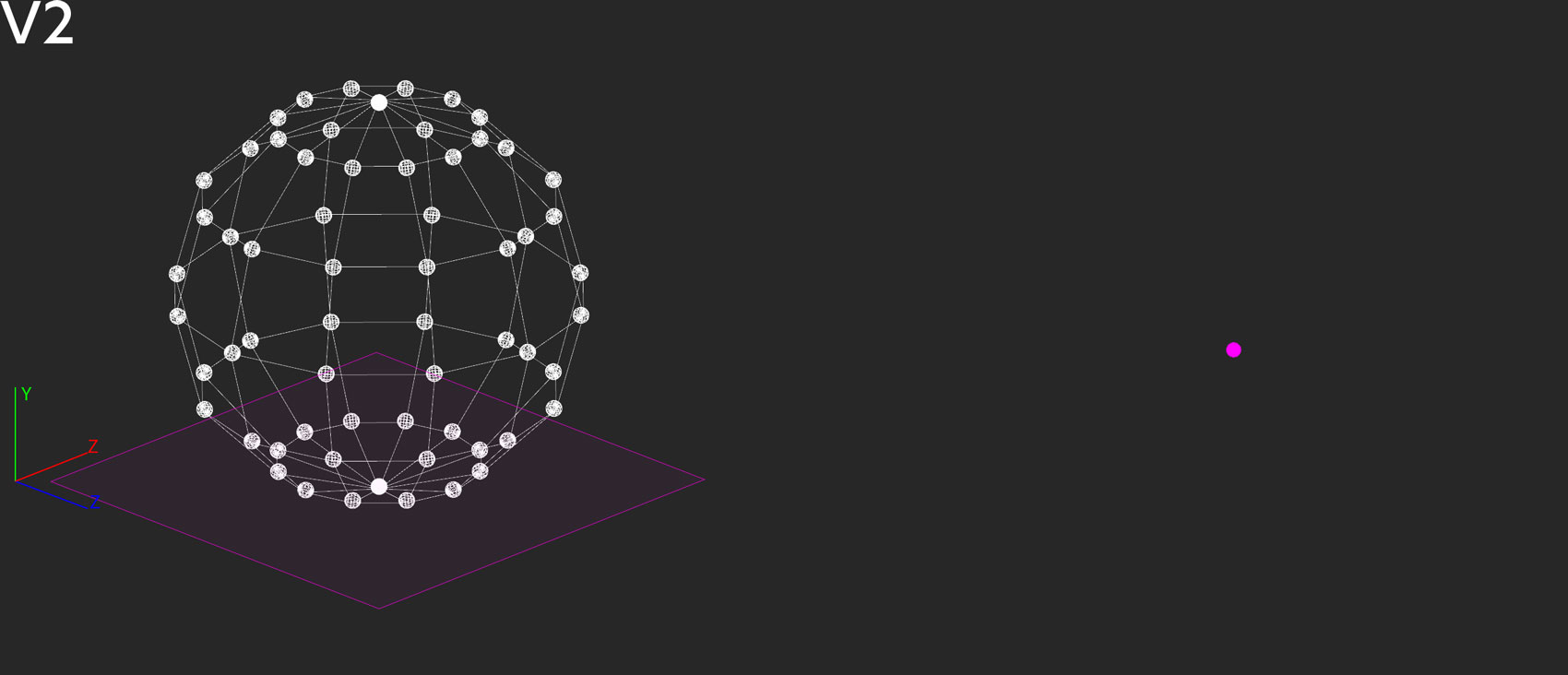
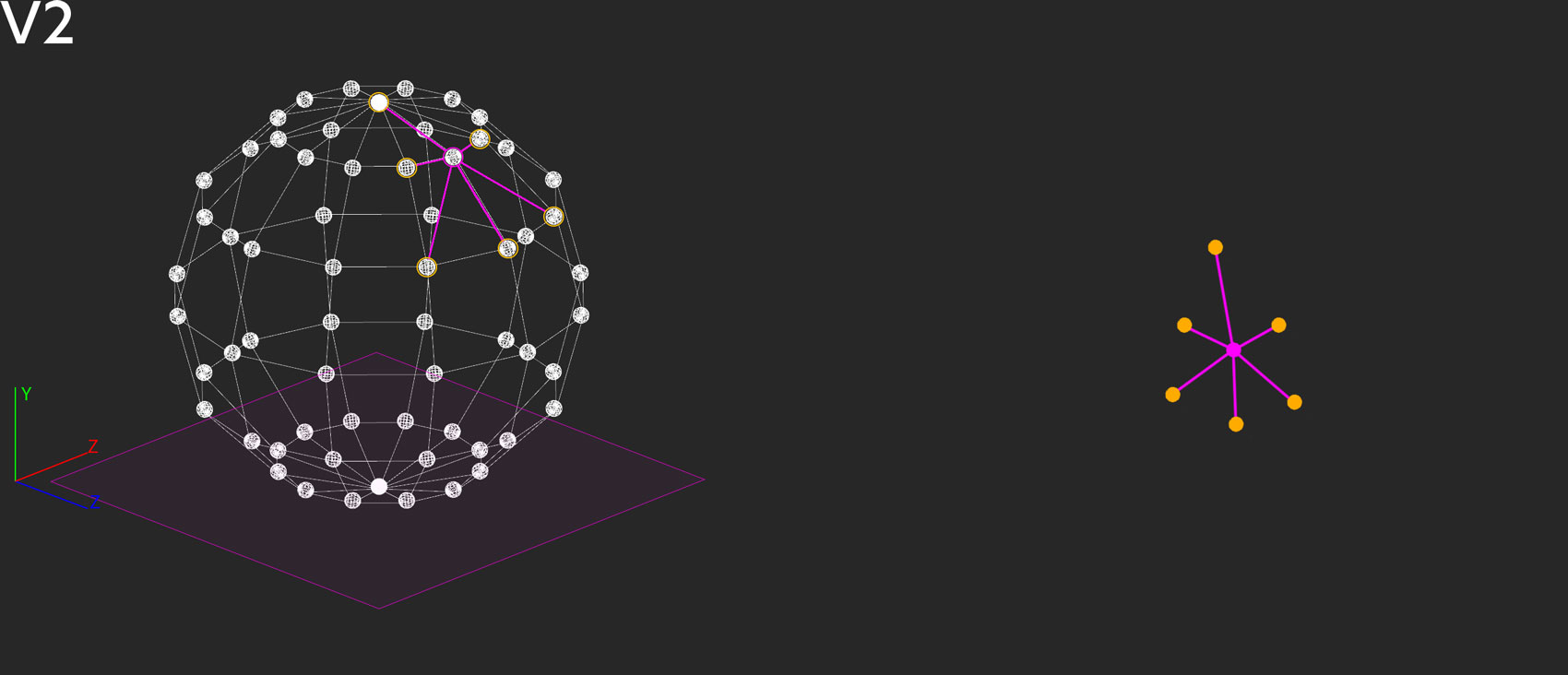
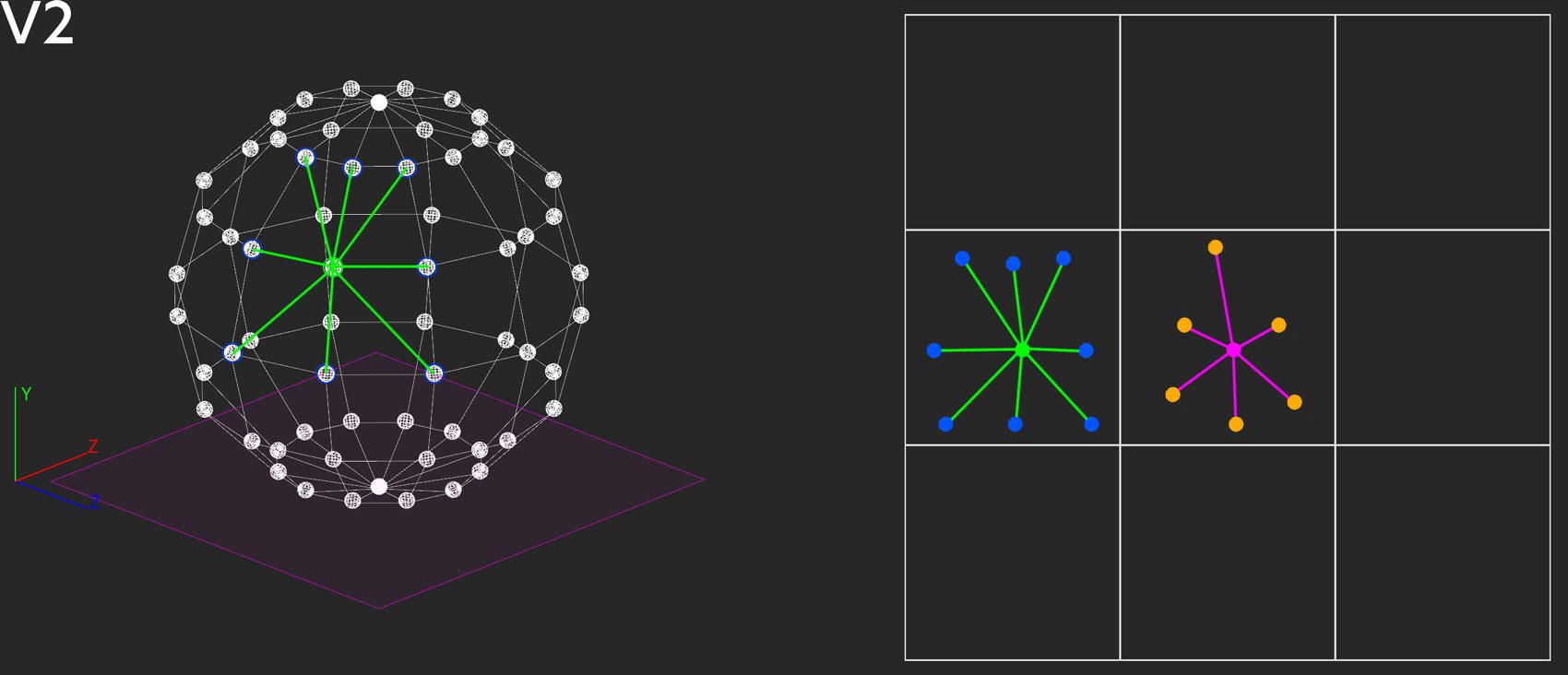
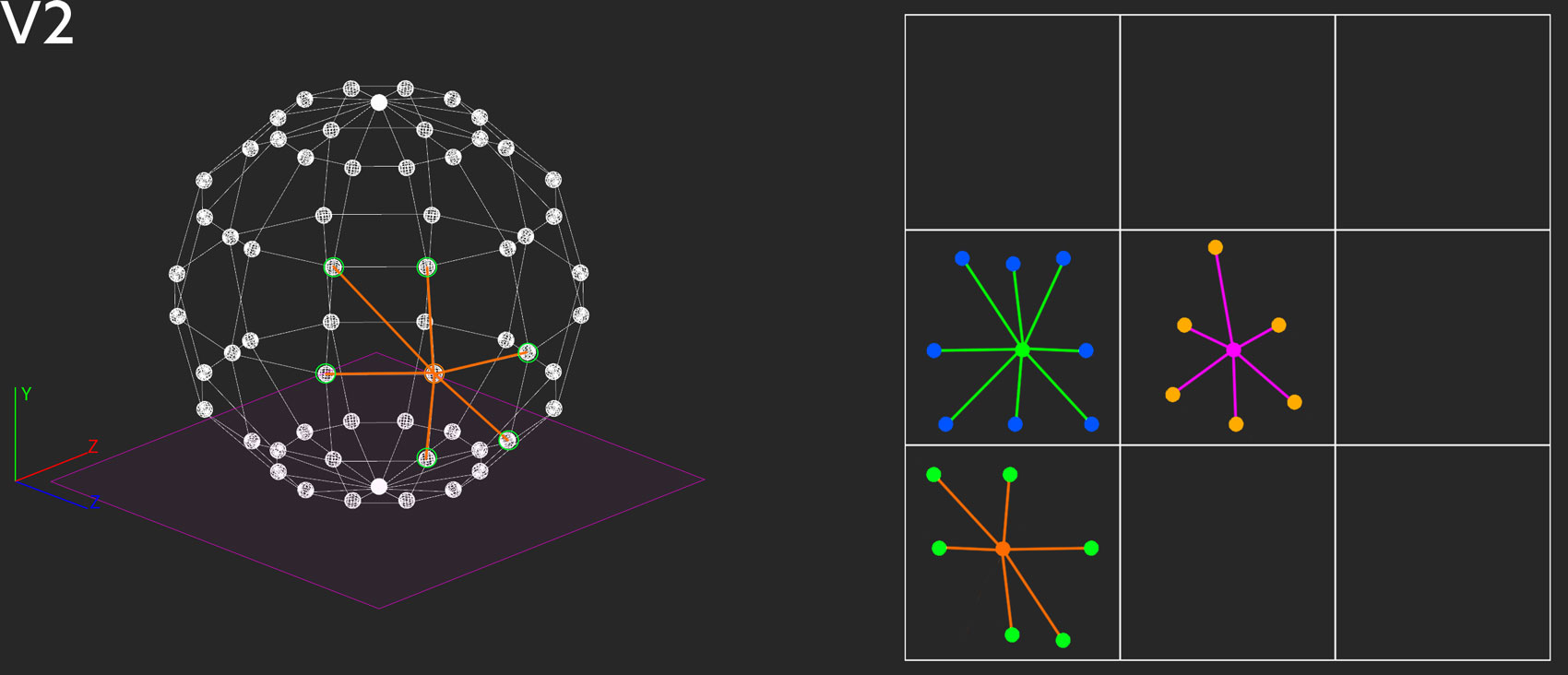
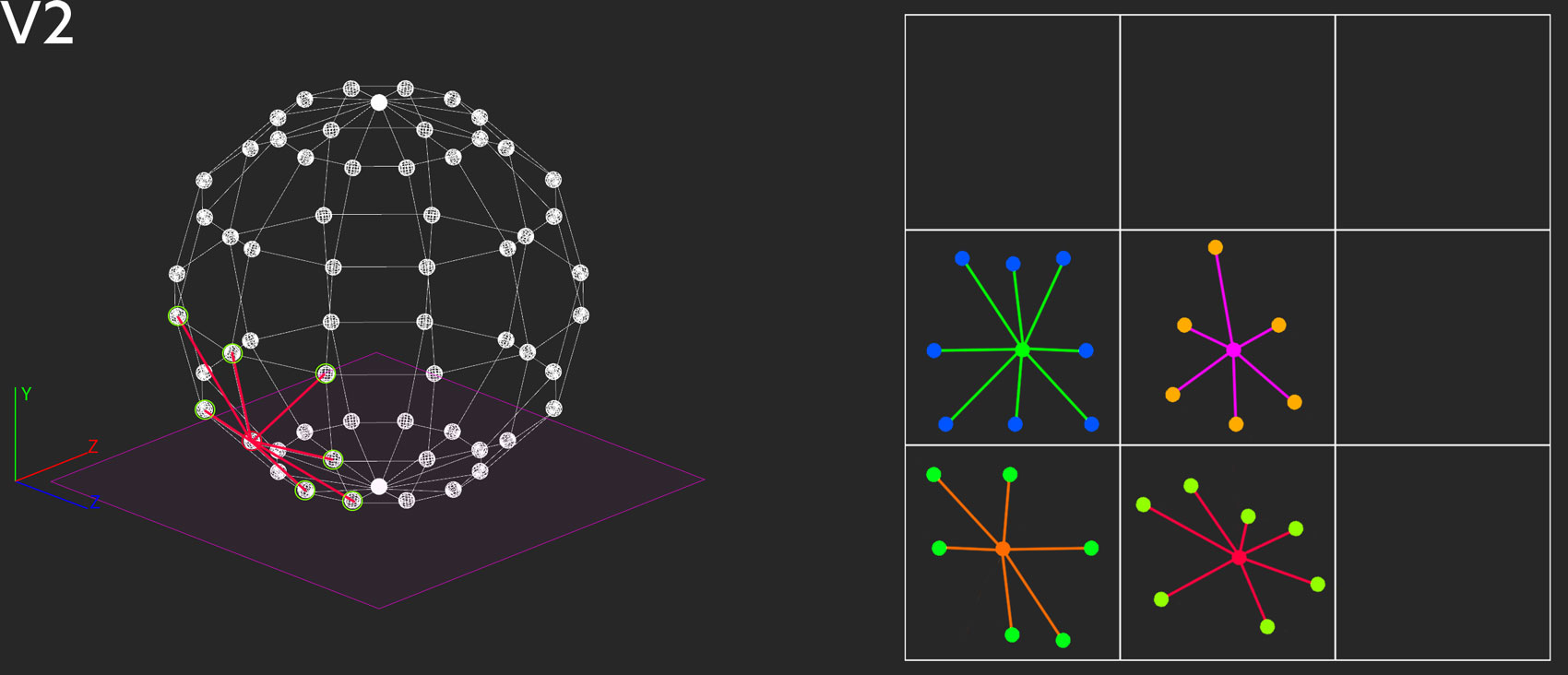
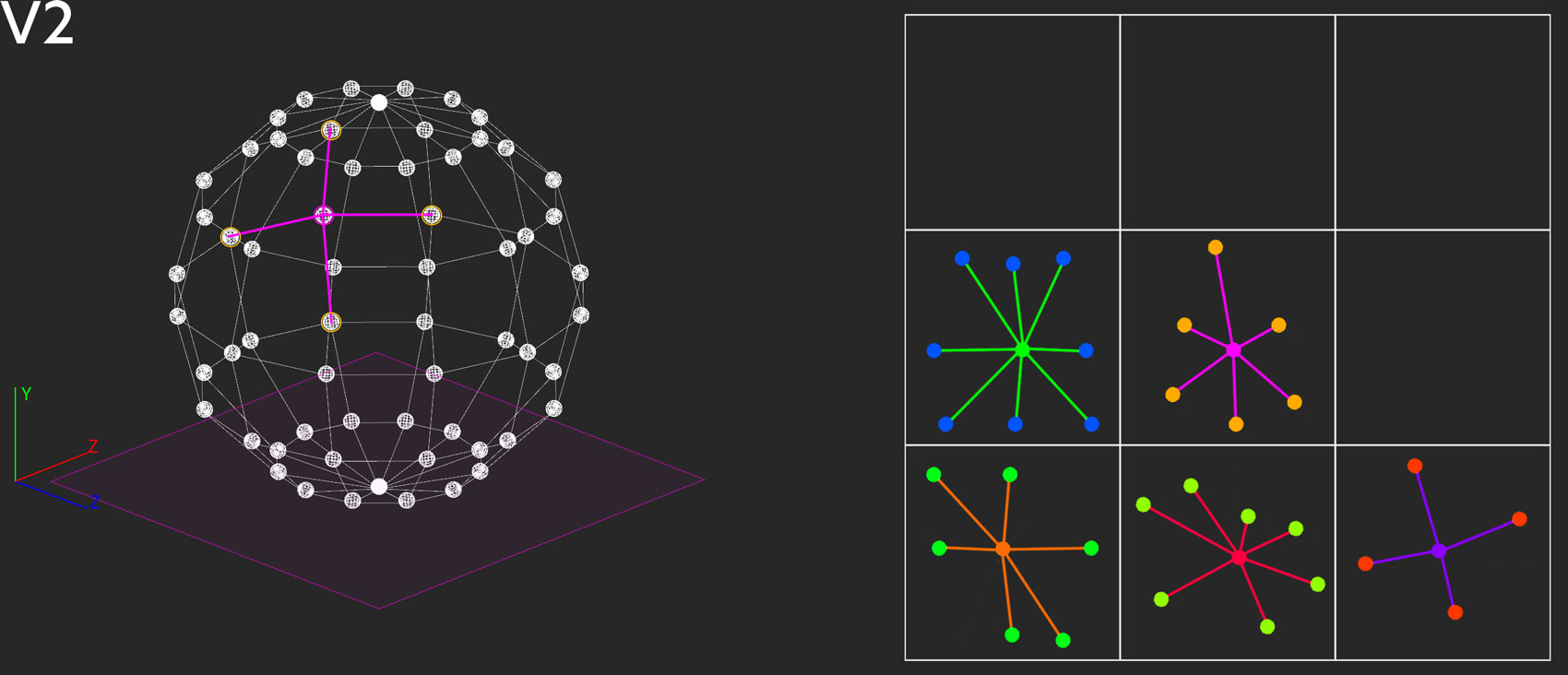
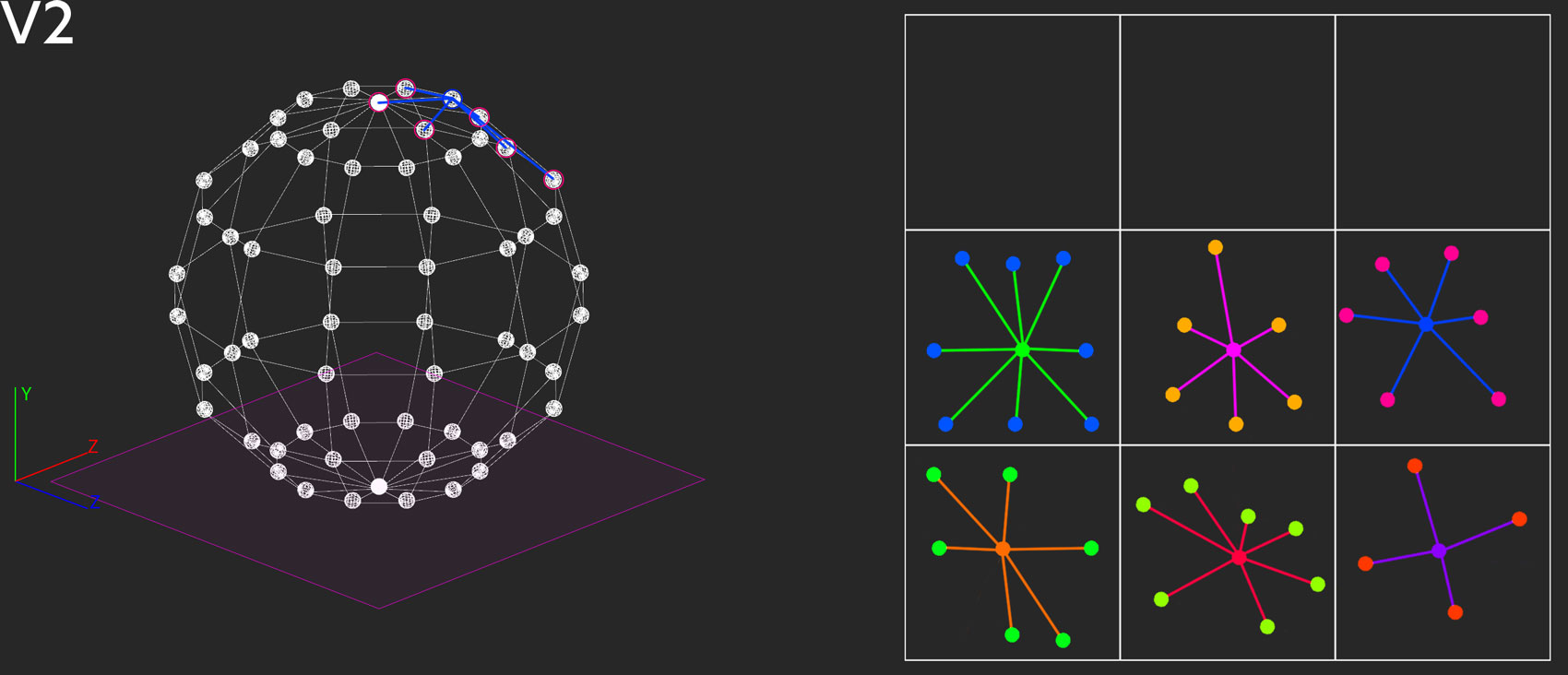
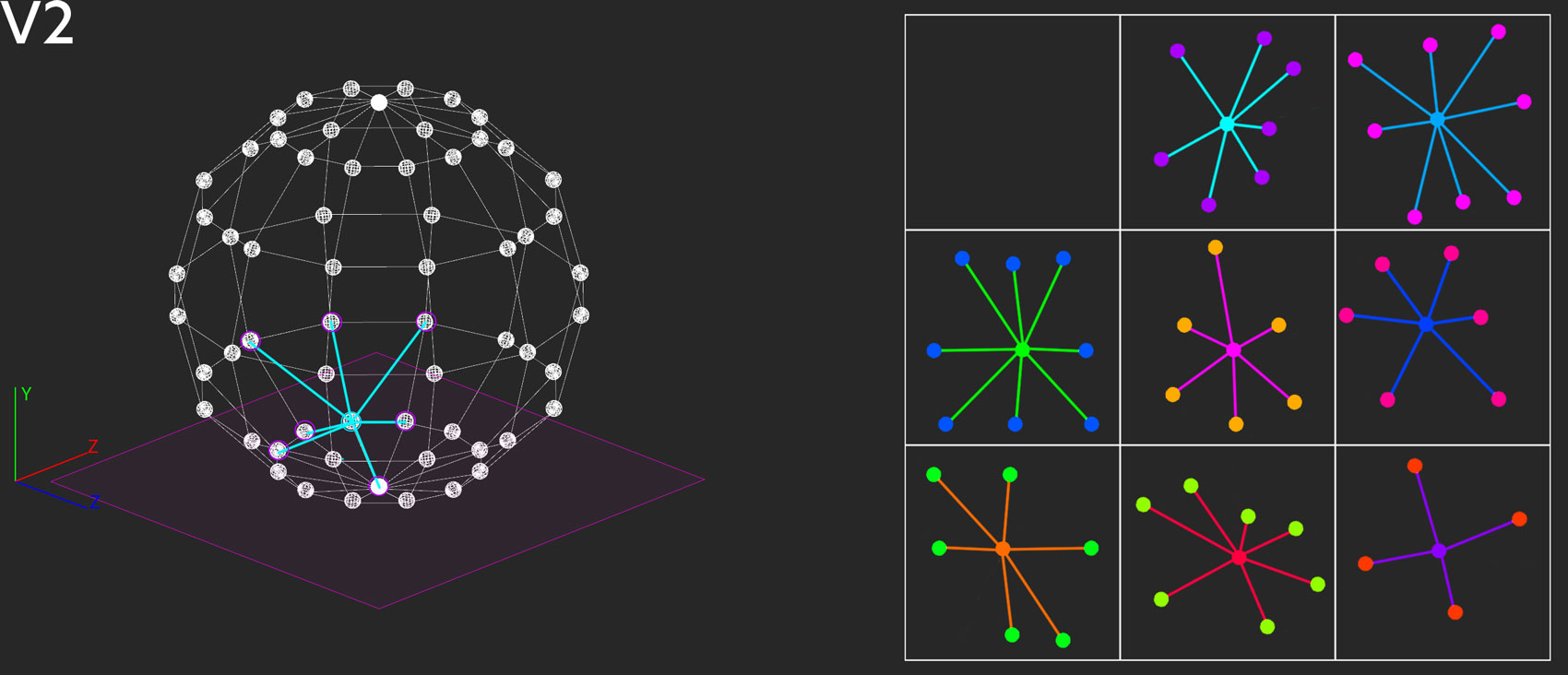
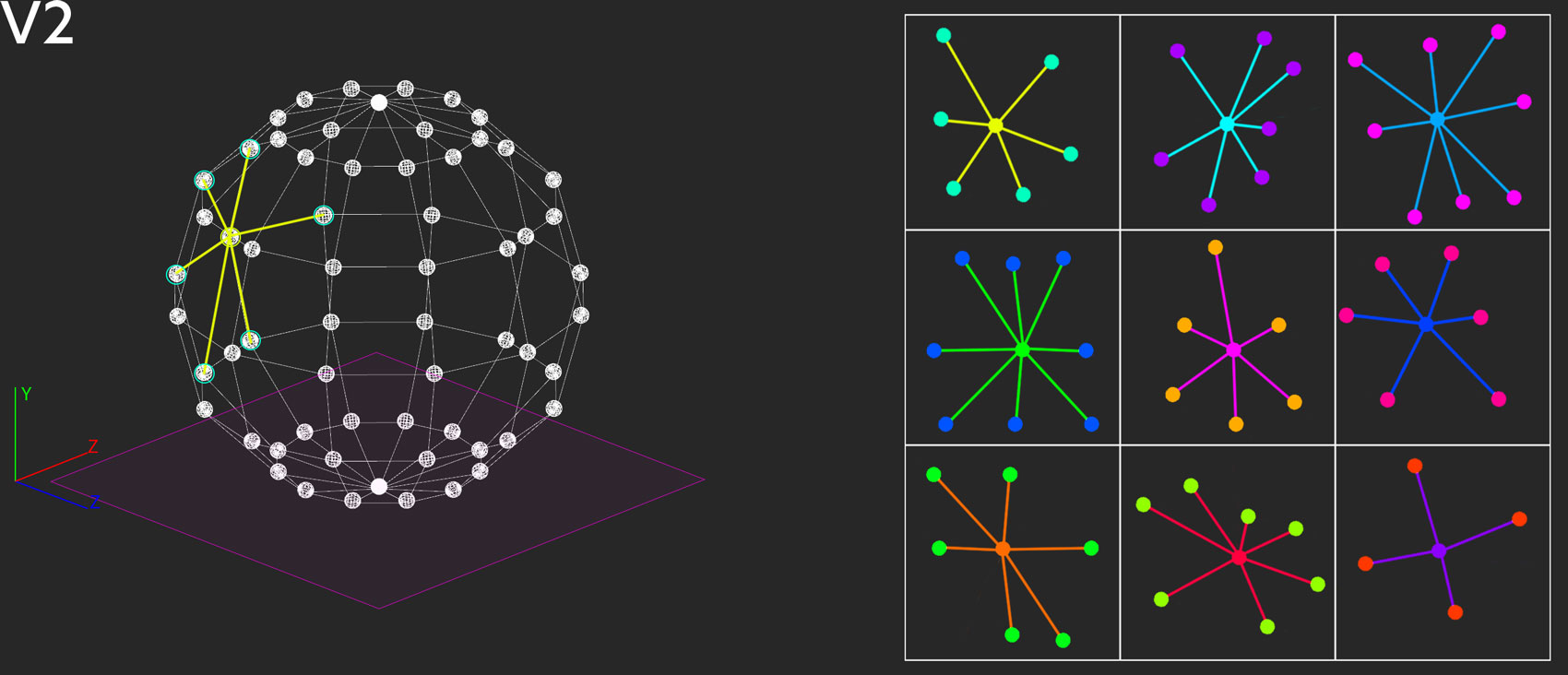
Suppose we select a point on the sphere and try to determine its nearest neighbors (V2). Using a simple mathematical operation (Cosine similarity), we can calculate how close the other points on the sphere are to the selected point. These distance relations can be then represented in two (or three) dimensions. The same operation can be performed for other points, resulting in a multitude of singular individual representations, each of which viewing the system from its own "perspective". Within these situational constellations, however, the considered facets of the original complexity remain. The result is a kind of scan of the 3D sphere. Its individual, situational representations summed up approximate the total, higher-dimensional complexity. This method, however, refuses to be represented in only one totalizing map as in the examples before, but requires a new situational configuration and processing for each query.
1 / 15
2.3 Mock-up
Now, let’s fill this perhaps a little bit elusive conception with more practical content and outline a hypothetical alternative knowledge management for VW Bib. Suppose we feed the library's entire collection in digital form together with the entire output of TU and UdK into an algorithm. Through the adjusted use of metadata and AI-based algorithms it’s conceivable to not only integrate conventionally accepted forms of written knowledge, like digitalized books, papers, or e-journals. (Digital media today makes the narrow concept of knowledge obsolete because it functions as a wholistic medium by combining the historically separated forms of media into one. On this fundamental digital infrastructure text, image, sound, and video are incorporated in codified form and therefore rendered exchangeable. Works of art have always been always delicate engagements with reality. As cultural artefacts they do contain softer (rather subjective) forms of knowledge that sometimes speak to us even more because of that. In the past artworks couldn’t be part of the scientific undertaking because there was no clear way to establish a direct communication between let’s say a painting and a book. Only when the painting got interpretated by an art historian it could then circulate as text amongst other texts. Digital media doesn’t differentiate between image and text. Everything is coded into zeros and ones.) To correspond to the manifold collection of actual knowledge that is stored in both universities, apart from bachelor's and master's theses also digital representations of artistic works of any kind will be incorporated. Personal profiles of students and staff will be added and linked to their own works. As result, we gain a multimedia database with text, images, video, and sound. The algorithm then brings all these elements into the high-dimensional vector space – into a relational, networked system. Parallel to the sphere from the previous example, we now use a search function to determine a point within the high-dimensional space and then determine its nearest neighbors.
2.4 Curriculum
A short thought experiment regarding a speculative curriculum: Students from both universities autonomously initiate joint research projects. With help of the search function outlined above, they can access the virtually stored knowledge of the library regardless of disciplines or subject areas. Furthermore, they can also access another great knowledge source which is very much available in the universities: themselves, the students, and their teaching staff. Humans are great catalysators of knowledge and there is hardly a more effective way of transferring knowledge than a conversation with another expert. The library now constitutes the central place where these people come together and interact with themselves and with all other various forms of multimedia content. With help of this technological mediation through the interface they form transitory bubbles that then extend into the physical space. By drawing together humans, text, video, sound etc. high degrees of complexity are created within those bubbles. All outcomes of these necessarily transdisciplinary collaborations, whether they last for a day or several semesters, are then uploaded back onto the database.
Via this closing of the feedback loop, an emergent, collective system is created. In this sense, the Volkswagen library, as a service institution for academic work, ultimately becomes the Ideathek. From a place of linear knowledge storage and consumption, it becomes a viral space for the undetermined generation of new ideas and thoughts where data, information, knowledge in all their forms are seamlessly brought into interaction – creativity through complexity, so to say.

3 Architecture: A platform for knowledge
3.1 Virtual and real-world platforms
In the course of the first Covid-19-lockdowns a work group formed within UdK to create a virtual equivalent to the real-world university life that was very much restricted in this time. On short notice, they designed a social platform based on the open-source Matrix protocol so that students and teachers have a common space for all sorts of communication. Its very powerful functionality allows not only for chatting, videocalling or the sharing of files with any other member of UdK. But it’s also possible to create groups, post on public notice boards etc. In this way the project went far beyond the original idea to provide a provisional solution for academic processes to take place. By the introduction of a virtual level, you could suddenly speak to people you would never have met because they usually stay in a different building. Groups can be flexibly created around one topic without having the need to book a room. You could easily stay in touch with classmates, despite of different schedules and curricula.
We take these basic forms of participatory and decentralized communication for granted on social media, but at least in my previous, analogue academic life interactions like that were harder to achieve. First of course, because the curricula don’t allow so – they rather work inwards; encapsulating and hierarchically restricting each study program to its assigned field. But second, also because the material environment (architecture) is clearly not designed for this sort of usages. Parallel to my critique of the tree-knowledge, architecture was (and still is) designed to host linear functional sequences. (The basic functional layout of most academic libraries looks more or less like this: 1. You enter an entrance hall. 2. You go to the lockers to leave your jacket and bag there. 3. You enter the actual library by passing a checkpoint. 4. You directly go to a vacant desk, or: 5. Go to look for a book/publication in one of the library racks. 6. You reverse all the previous steps to leave the library again. Additionally, the behavioral rules in library spaces restrict interaction as much as possible.) In the last decades, with the help of digital technology’s inherent functioning, a new spatial regime has been established, which particularly invokes a relational conception of space based on participation and decentralization. Why shouldn’t our real-world spaces enable similar processes as our virtual ones? There is the fear nowadays that our social life takes place more and more in virtual spaces. In my opinion this tendency is not only due to the virtual ones being too invasive but also because our real-world ones lack basic qualities to meet the legitimate expectations of a more flexible and interactive functionality.
1 / 5
3.2 Architectural interventions
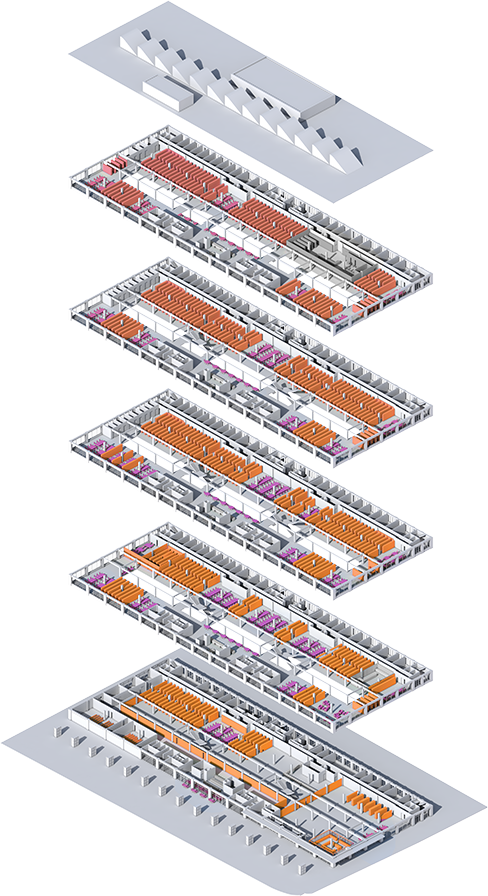
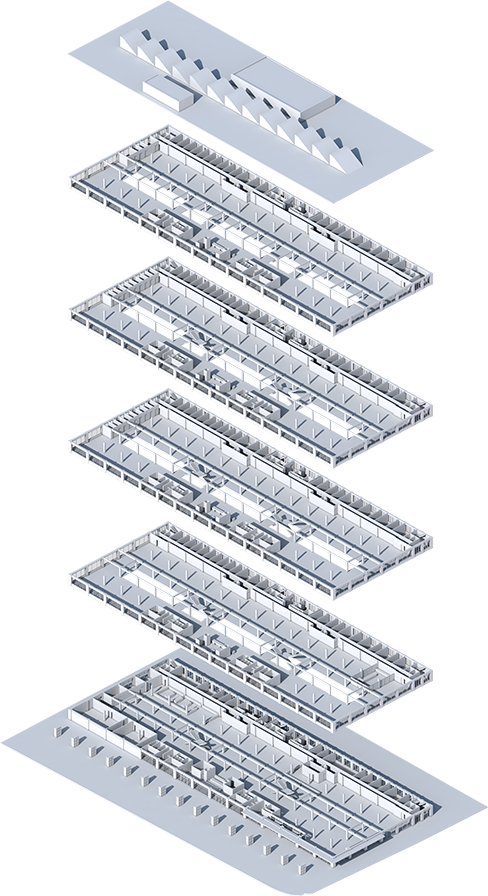
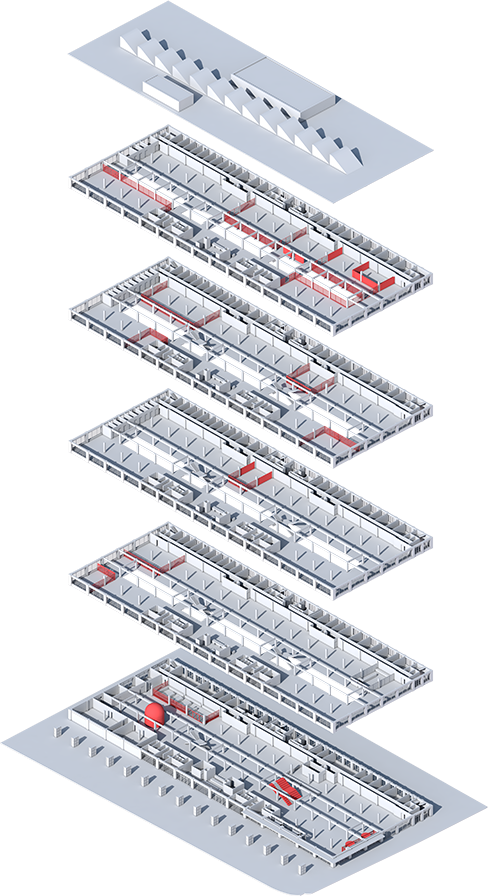
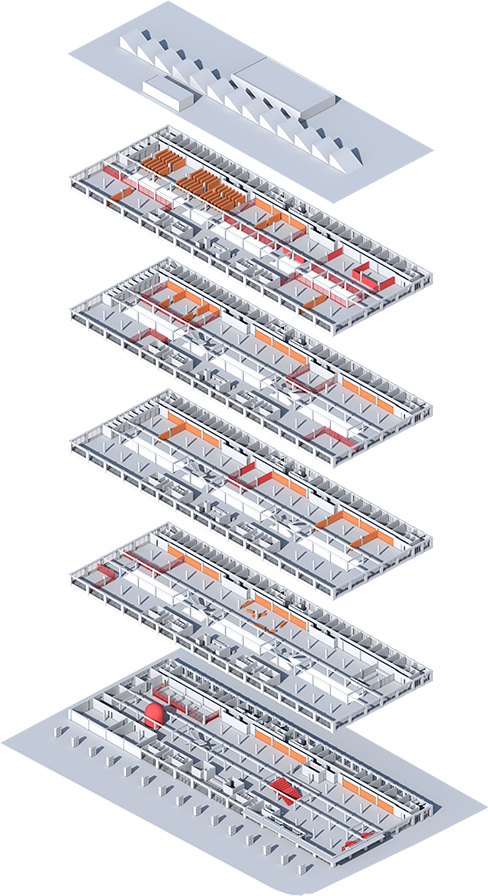
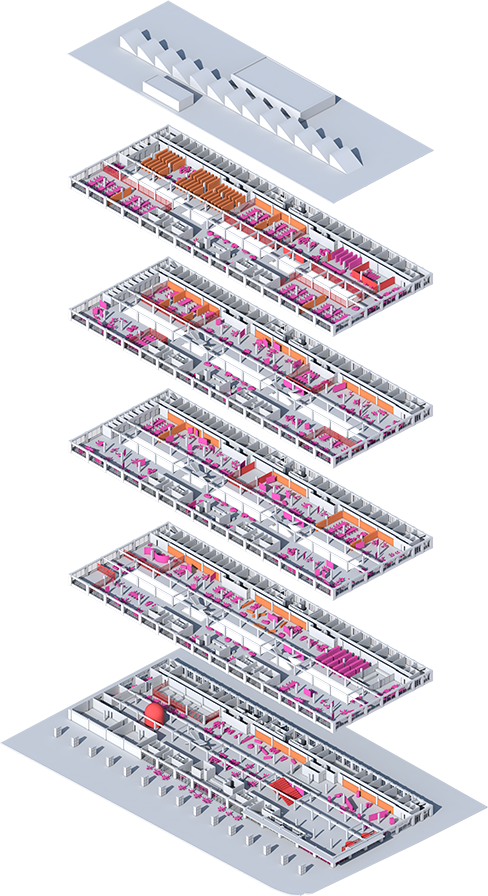
Let’s see how this could be implemented in concrete terms. The isometrical images above show the actual conversion measures for all floors. Graphic 1 depicts the current state of the building, the bookshelves in purple, individual workstations in orange. It is striking that the internal organization is defined almost exclusively by these two functions. This dual spatial program results in a correspondingly limited offer of possible activities. Additionally, the library today is a space provided with stringent rules and norms. In this sense, it is also hierarchical and unfolds only small degrees of freedom. The whole space is construed around the medium of the book: how to store it and how to work with it. Now, to see what other usages could be conceived when the primary status of the book is left out, we first must radically clear the space to then fill it with digit-based new functions. Graphic 2 accordingly shows the empty library. Only the mere structure is left so that a new digital reorganization can follow. In the next graphic, we see the proposed redesigning measures in red. Only small interventions are intended: A new entrance will be added to open up the main hall to the surrounding urban space. The front staircase will be extended with bigger steps for seating so that it converts into a meeting point with representative quality. A smaller room is added at the back of the ground floor where collective VR-experiences are facilitated through big LED-walls. All the remaining interventions otherwise are light-built glass walls that will function as partitioning walls for acoustic insulation. Graphic 4 provides an overview of the bookshelves that will return into the building. Only the most used and required books are supposed to stay in the actual Ideathek space itself. The rest will be moved to a nearby storage space, from where they can easily be ordered if needed physically. The room thus freed up will be filled with other furniture, as graphic 5 shows. We'll come back to their purpose and function in a moment.
The general goal in the conversion was not to make big interventions that drastically transform the building. My approach works with what is already there and keeps the changes at a minimum. It’s about “reprogramming” the space. Or put another way: how can minimal 'hardware' changes create maximal 'software' improvements?
1 / 5
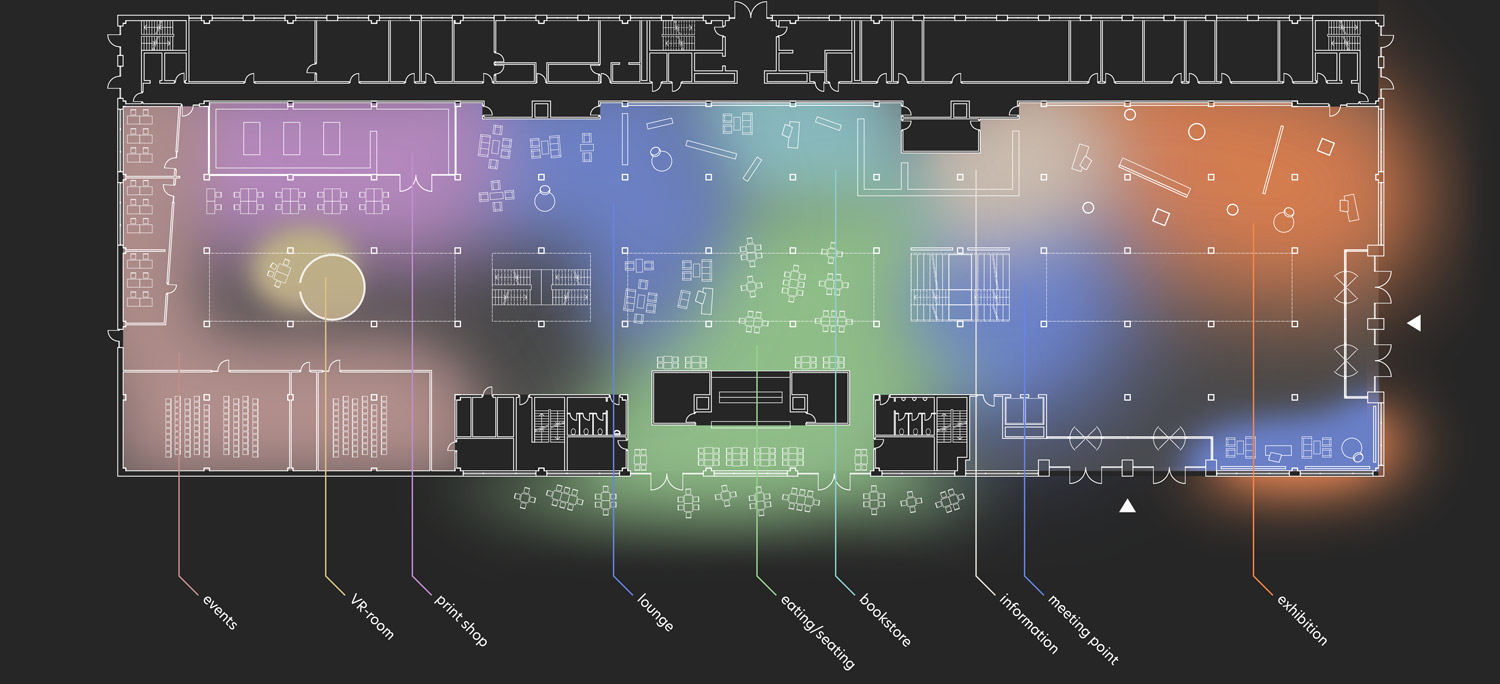
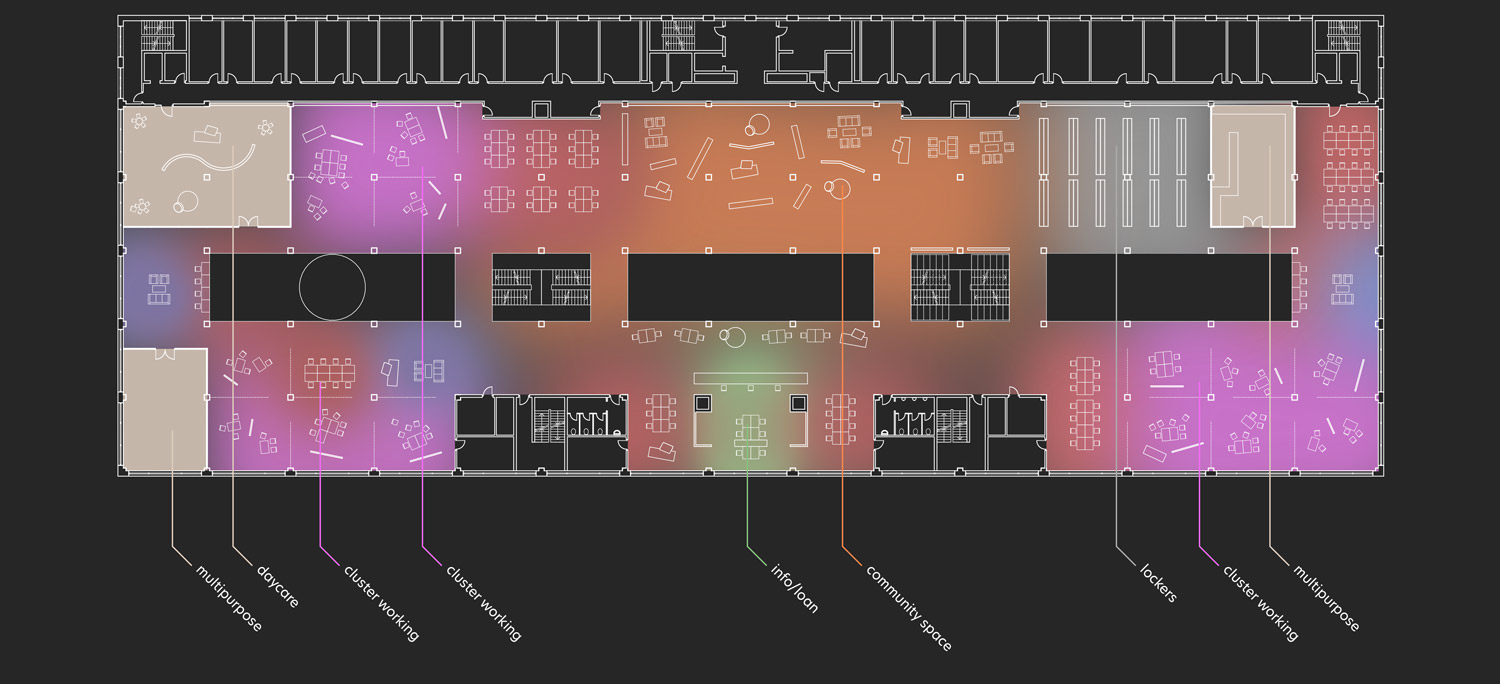
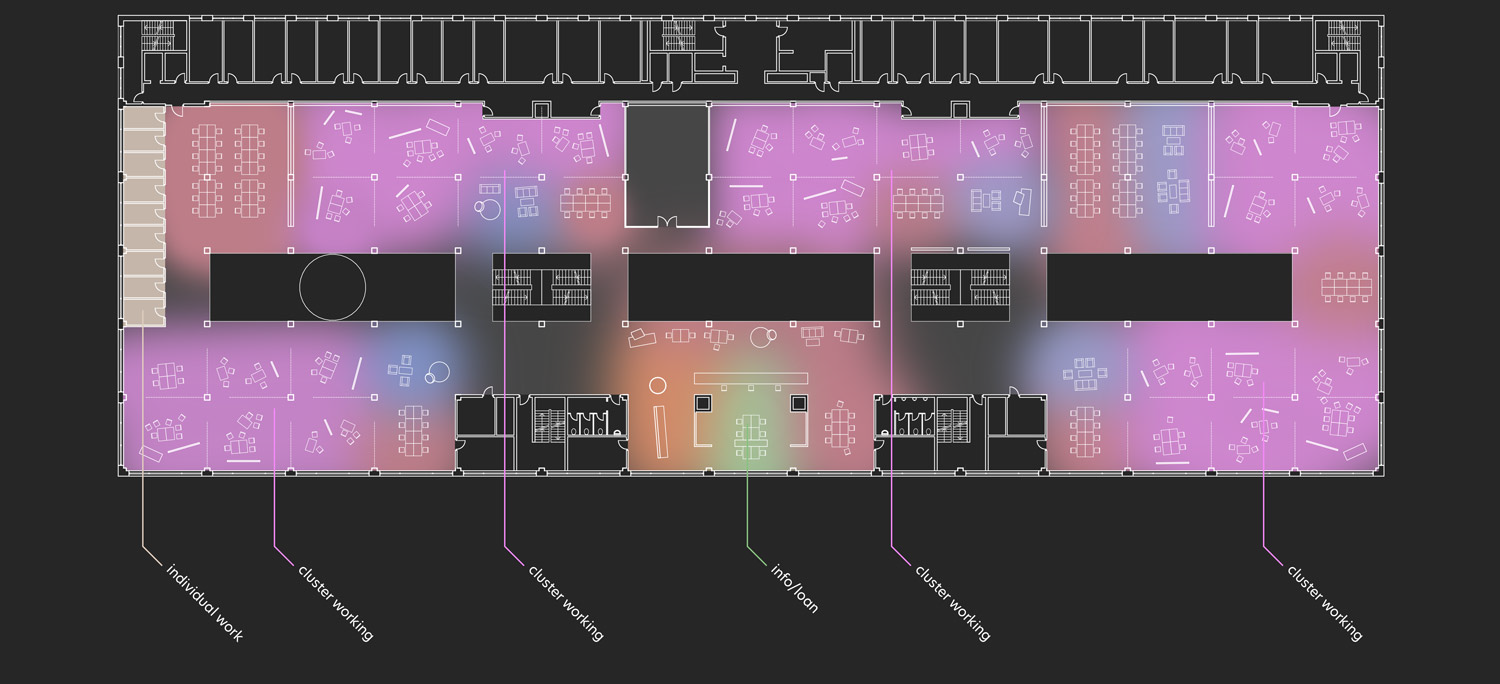
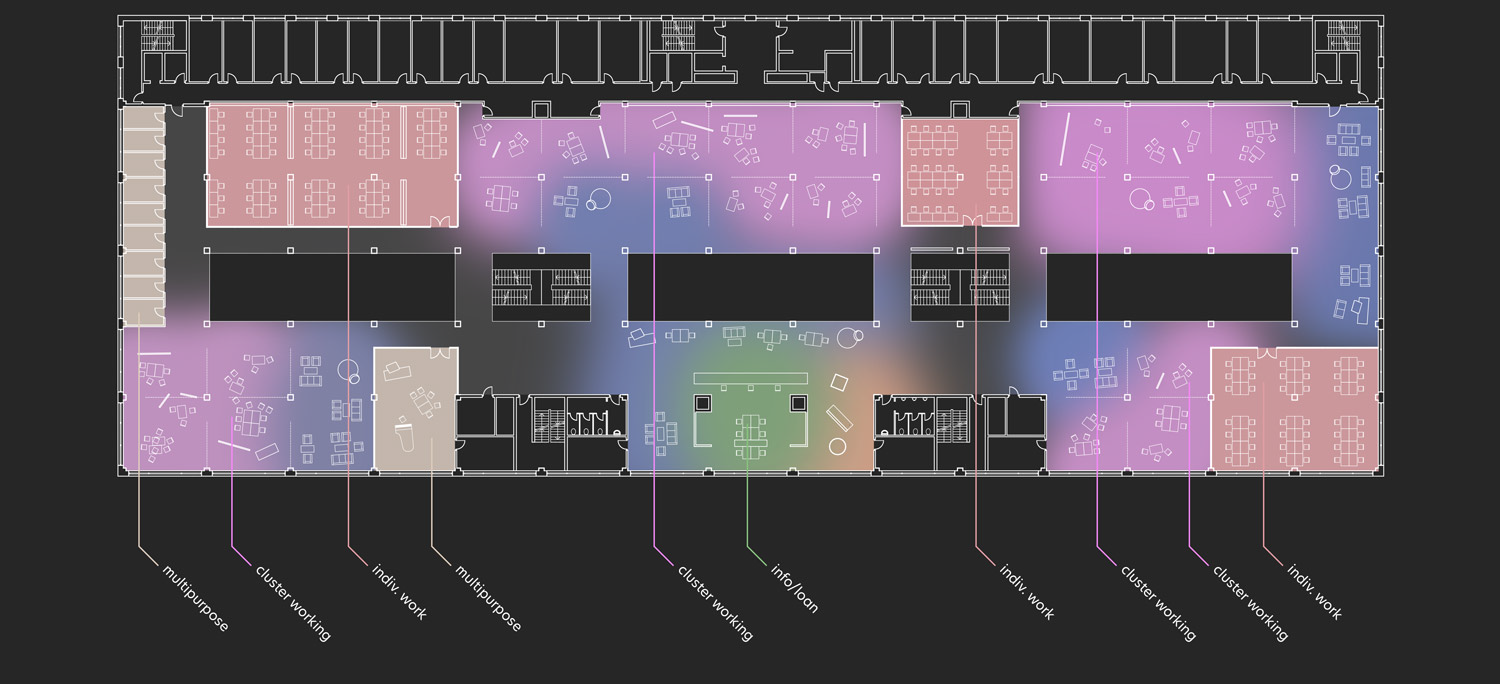
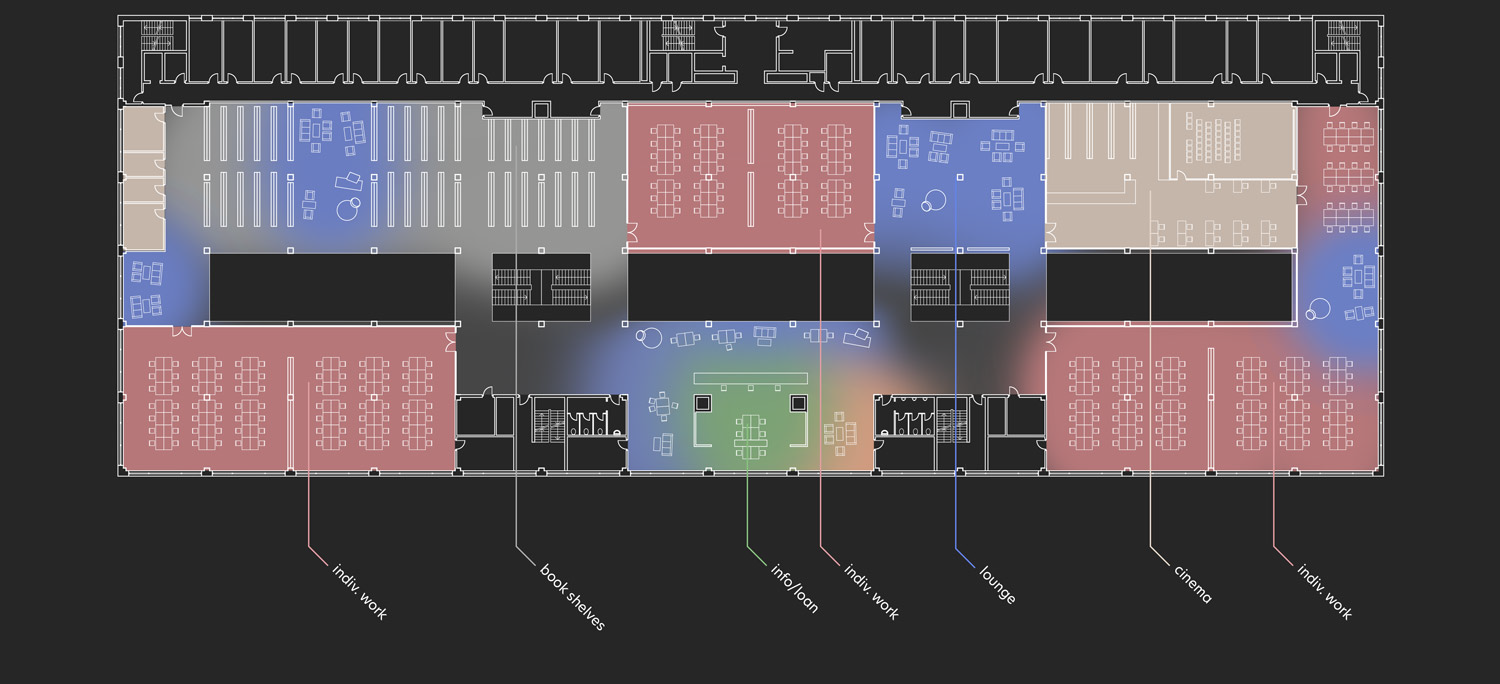
All interventions can be checked in detail on the floor plans above but allow me to summarize the most important transformations. Ground floor: Instead of limiting accessibility through barriers and prescribing a uniform way of use, spatial and programmatic demarcations are radically removed. Additionally, public functions are located here (e.g., student-organized exhibition space, info desk, bookstore, restaurant, VR-room, print shop, seminar and event rooms). The offers are not only directed at the actual users of the workplaces on the upper floors, but are also supposed to attract passers-by, therefore activating the whole floor for everyone in the academic community. Corresponding to the notion of a platform, a dynamic and nonlinear spatial configuration is created that connects multiple and heterogeneous activities in a decentralized manner. The formerly individual functions can thus communicate. In this nonlinear networking, a spatial indeterminacy is created that generates emergent actions. The 2nd floor defines a transitional space between the public area of the ground floor and the working zones on the upper levels of the Ideathek building. Infrastructural functions are located here facilitating the visit, like a childcare center or lockers. In the so called “community space” already more productive but still playful functions are offered. For example, collectively curated media shelves are located here where the community can autonomously gather and discuss content on a relevant topic. Or large interactive screens can be used to collectively browse knowledge via the above-outlined search interface. But also, some learning-clusters are already situated here, that define the core of the Ideathek-concept. We will come back on these in a bit, let’s go through the rest of the floors for the sake of completeness. On the 3rd floor, we see that it is mostly made up of learning-clusters. One new function is added here: areas acoustically isolated by glass walls accommodate the quiet individual work as we know it from today's libraries. The 4th floor consists mainly of these secluded zones for individual work. Parallel to that, the only large stock of books in the building is located here. Finally, the library's existing media collection will be supplemented with a projection room.
Contrary to the clearly structured linear organization of the former library, the Ideathek offers maximum spatial diversity. It doesn’t just overwrite the existing functions but complements them with a variety of new ones. Nevertheless, there is also a certain differentiation in the vertical: from more public and communal functions on the lower floors, to more protected, individual functions on the upper ones. Instead of clear boundaries between the single functions, it seeks to establish fluid, functional continuums that enable a highly differentiated range of possible activities. Participative interaction is promoted to overcome the dualist setup of designers and users (or producers and consumers) – rather everyone shapes the space through its use. Hierarchical formality is turned into an emergent, informal interplay of humans and technological knowledge carriers.
3.3 Learning-clusters
Now, let’s have a look at the before mentioned learning-clusters. Each of them consists out of different types of furniture sets to facilitate various usages. But a cluster’s functionality is fluid: users can oscillate between the functions according to their temporary needs. Couches and armchairs in blue offer an informal, casual experience. The red table grouping is more reminiscent of conventional workstations for individual activities. Curtains can be used to create temporary zoning. And then there are the pink furniture sets, which we will look at in detail now.
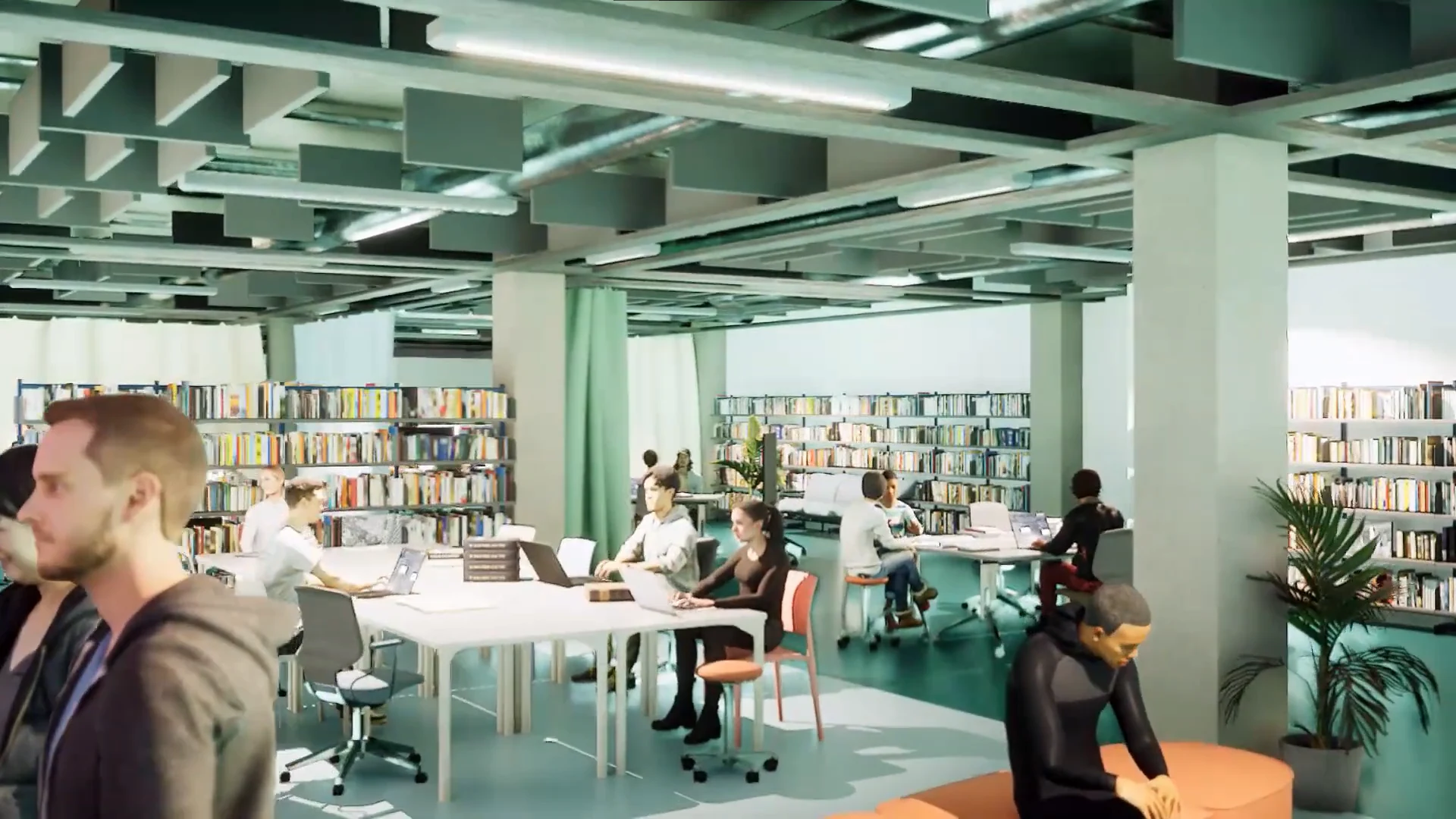
In the graphic above, besides a group of student users and conventional furniture like tables and chairs, it stands out that there are a lot of displays: a large screen for shared content and video conferencing, laptops, and tablets. But next to the digital devices there are books and paper-based notepads, too. Multimedia working units, like this exemplary one, are the core element of the Ideathek. Here, the projects initiated by the students take place. And here all the available knowledge carriers come together: digital, analog, human. Parallel to the dynamic and self-organized modulation on the interface level, the students will find in the Ideathek a flexible and interactive space that can be correspondingly occupied and individually adapted in situ. The design attempts to implement a new mode of collaborative knowledge prosumption (simultaneous consumption and production) based on the principles of networked technology compiling the notions of flexibility, interaction, transdisciplinarity and nonlinearity. It is the final spatial fold which extends the algorithmically generated, virtual space, via the mediation of the search-interface to material reality. In doing so, it recreates the situational configurations, passing on the complexity inherent in the high-dimensional system of the universities. Within those socio-epistemic situations knowledge is brought into circulation and communication to produce a condensed, lateral milieu for the generation of creativity and new ideas.
Instead of an overdetermined spatial configuration, the users are empowered to shape the space themselves through interaction on all spatial levels. From the interface to the actual building – by uploading their work on the database or by creating spontaneous, flexible working environments in virtual or real-world space: they become knowledge and space creating agents themselves. With this in mind, we finally break away from the ideal of a functionally pre-planned and well-structured library. The Ideathek building itself could be understood as a kind of collective interface. In the sum of the activities taking place in it, it forms an unpredictable, ecological system approximating the stored complexity of the epistemic system of TU and UdK.
3.4 Augmentation through apps
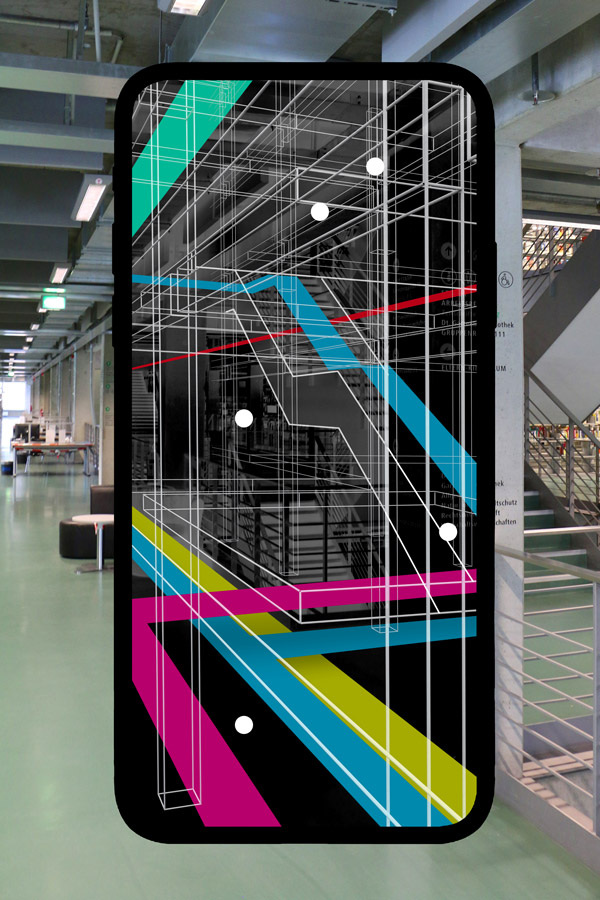
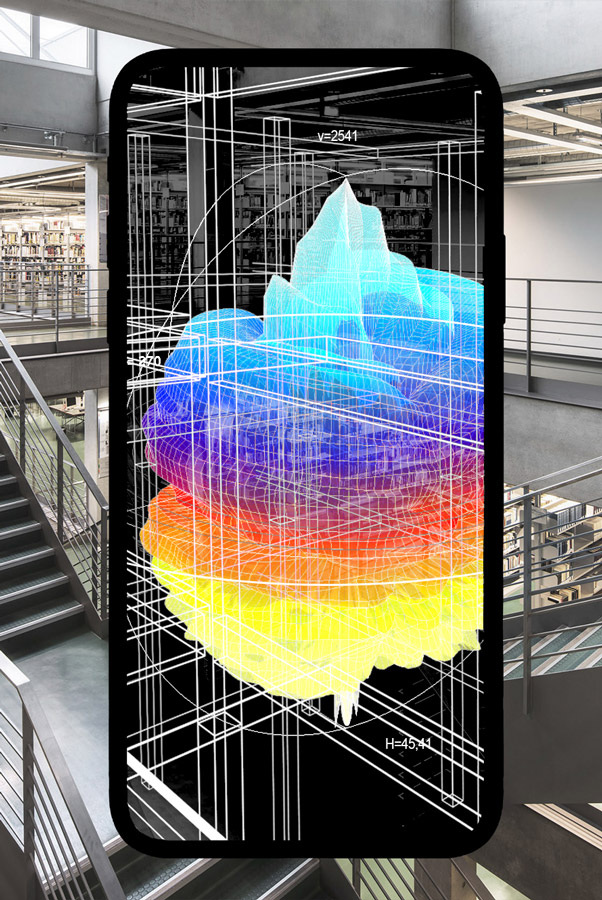
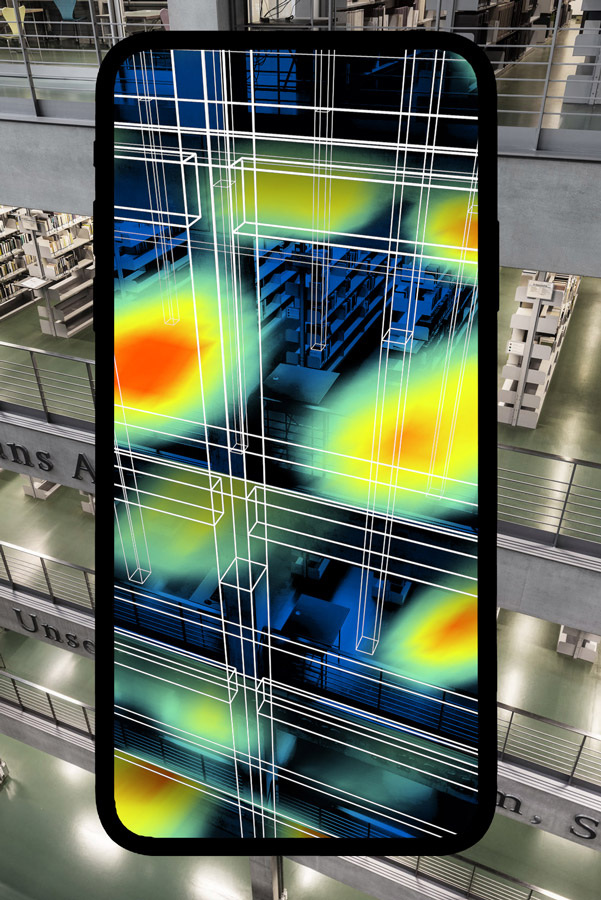
The Ideathek seamlessly spans over not only the physical building but also its virtual extensions. This blending between real and virtual becomes even more apparent if we consider just a few possible functions for an augmented-reality app. Suppose the building and all items was equipped with a RFID-system the app could then be used to locate books and equipment quickly and easily with the help of electromagnetic waves. For the book racks, this would have an important implication: it would no longer be necessary to arrange books in any order at all. Through the app, one could find a book and then put it back on any shelf. It would still be found again. The collection could in this way be curated by the community itself. There could be other gimmicks in this app, such as a heat map to easily find available and suitable workspaces . Or a function to embed community generated virtual contents as augmentation into the building to exhibit art works or diagrams publicly.
4 Conclusion
Architecture can provide the suitable spaces for epistemological subjectivations/encounters with knowledge as libraries did in the past, but only if architectural design manages to expand into the depths of space opened by digital technologies. The boundaries between reality and simulation are blurring and architecture cannot limit itself exclusively to the “physical” but must include all spatial levels between virtual and physical. It must open itself up and create coalitions with other design disciplines, ranging from interface design to even supposedly unfamiliar fields like software engineering.
Some might wonder why there is still a need for physical places at all, why shouldn’t everything happen fully virtually? I think that this point of view reproduces a binary logic again and denies the full range of human experience. To produce something like knowledge we are very much dependent on our perception, affect and bodies within their local contexts. This embedded understanding of knowledge emphasizes the importance of our physical, corporal presence.
It is a common perception that a new complexity seems to emerge which is consequently paralleled by a new lack of clarity. What I learned through this long-term project was that the world always inhered this complexity. We just weren’t able to trace and process it with the historically available technological means and therefore had to neglect it, reduce it. My project was the attempt to develop a design approach that is based on the idea that we don’t have to compress the world into our limited conceptions but to rather open ourselves up to them – to affirmatively embrace complexity and differences. I think that this epistemic door was opened by our contemporary digital tools (amongst other things) which enable a broader and more in-depth interaction with what is around us. Digital technologies push to create communicative connections and thus create the possibility for networked, relational systems. Not only can they asymptotically approximate the real complex relations, but also generate interaction and thus collaboration due to their tendency to openness.
1 / 3